
Definition:
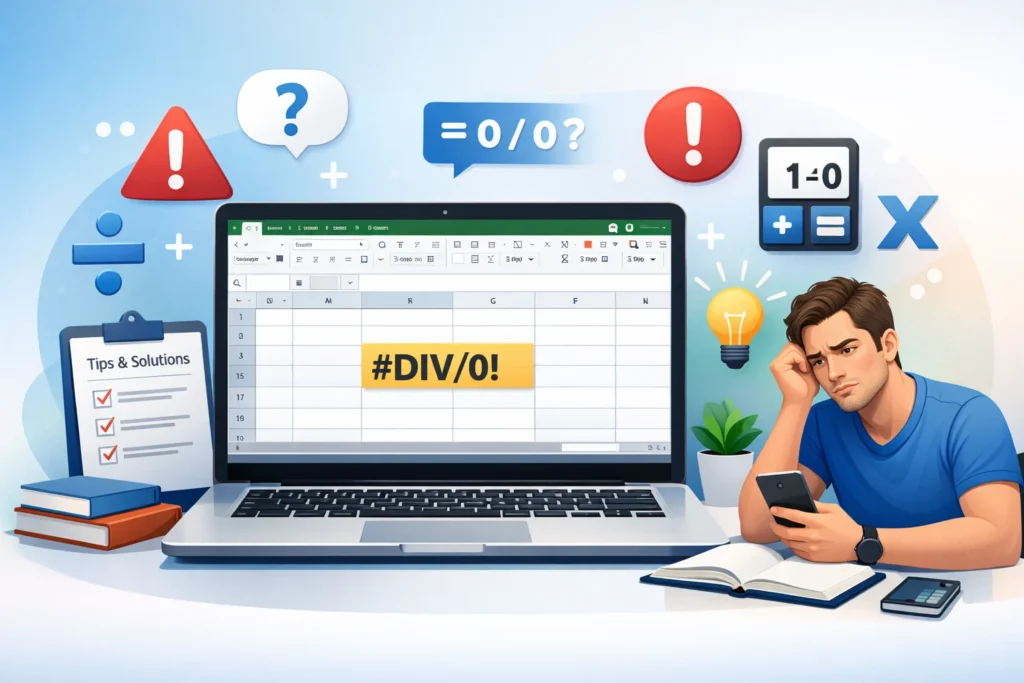
#DIV/0! in Excel is an error that appears when a formula tries to divide a number by zero or by an empty cell. Excel cannot perform division by zero, so it displays this error to indicate an invalid mathematical operation.
If you’ve ever worked in Excel and suddenly seen a strange message like #DIV/0!, you’re not alone. This is one of the most common Excel errors and also one of the most misunderstood by beginners.
At first glance, it may look scary or like something is broken in your spreadsheet. But in reality, #DIV/0! is simply Excel’s way of telling you that it cannot divide a number by zero or a blank value.
Whether you’re working on financial reports, school assignments, business dashboards, or data analysis, this error can pop up unexpectedly. The good news? It’s easy to understand, fix, and even prevent once you know what causes it.
In this guide, we’ll break down everything about what does #DIV/0 mean in Excel, including its origin, real-world usage, examples, comparisons, and practical fixes so you never get stuck again.
Origin and Meaning of #DIV/0! in Excel
The #DIV/0! error comes from the mathematical rule that says:
❌ You cannot divide a number by zero.
Excel follows strict mathematical logic. So whenever a formula attempts:
- A number ÷ 0
- A number ÷ empty cell
- A number ÷ blank value
…it returns #DIV/0!
Why does Excel show it?
Excel displays this error because:
- It wants to alert users of invalid calculations
- It prevents incorrect or misleading results
- It follows standard arithmetic rules
Simple breakdown:
| Situation | Result |
|---|---|
| 10 ÷ 2 | 5 |
| 10 ÷ 0 | #DIV/0! |
| 10 ÷ blank cell | #DIV/0! |
This error has been part of Excel for decades and is one of the earliest built-in formula error types.
Why #DIV/0! is So Common in Excel
The #DIV/0! error in Excel is extremely common because spreadsheets often include:
- Empty cells
- Incomplete data entry
- Dynamic formulas
- Automated calculations
For example:
- Sales data not yet filled
- Average calculations with missing values
- Growth percentage formulas
- Survey or form-based spreadsheets
Even a single blank cell in the wrong place can trigger this error.
Real-world scenario:
Imagine calculating:
Profit per unit = Total Profit ÷ Number of Units Sold
If “Units Sold” is accidentally left blank or 0, Excel immediately shows:
➡ #DIV/0!
Common Usage and Real-World Examples
Let’s understand how this error appears in everyday Excel use.
Example 1: Basic Division Error
| Value A | Value B | Formula | Result |
|---|---|---|---|
| 100 | 0 | =A2/B2 | #DIV/0! |
Example 2: Blank Cell Issue
| Value A | Value B | Formula | Result |
|---|---|---|---|
| 50 | (empty) | =A3/B3 | #DIV/0! |
Example 3: Average Calculation
If you calculate:
=SUM(A1:A5)/COUNT(A1:A5)
But COUNT returns 0 (because all cells are empty), Excel shows:
➡ #DIV/0!
Tone-based interpretation in real life:
- Neutral: “The formula returned #DIV/0! because the divisor is zero.”
- Frustrated user: “Ugh, why is Excel showing #DIV/0! again?”
- Beginner confusion: “What does #DIV/0 mean in Excel??”
How to Fix #DIV/0 Error in Excel
Now let’s talk about solutions. Fixing this error is simple once you know the methods.
1. Replace zero with a valid number
Ensure the denominator is not zero.
2. Use IF function
You can prevent errors using logic:
=IF(B2=0, "", A2/B2)
This means:
- If B2 is 0 → show blank
- Otherwise → divide normally
3. Use IFERROR function
=IFERROR(A2/B2, "No Data")
This replaces the error with a friendly message.
4. Check for blank cells
Always ensure:
- Required data is filled
- No missing values in key columns
5. Use conditional formatting (advanced)
You can highlight error cells for easier debugging.
Example Fix Table
| Formula Issue | Problem | Fix | Result |
|---|---|---|---|
| =A1/B1 (B1=0) | Division by zero | IF(B1=0,””,A1/B1) | Blank instead of error |
| =A1/B1 (B1 empty) | Missing value | IFERROR(A1/B1,”N/A”) | Clean output |
| =SUM(A:A)/COUNT(A:A) | No data | Add IF condition | Prevent error |
Comparison: #DIV/0 vs Other Excel Errors
Excel has multiple error types. Here’s how #DIV/0! compares:
| Error | Meaning | Cause |
|---|---|---|
| #DIV/0! | Division by zero | Invalid denominator |
| #VALUE! | Wrong data type | Text used in formula |
| #REF! | Invalid reference | Deleted cell reference |
| #NAME? | Unknown function | Misspelled formula |
| #N/A | Missing data | Lookup value not found |
Key difference:
👉 #DIV/0! is specifically related to division problems only
Alternative Meaning or Misunderstanding
Some users mistakenly think #DIV/0! means:
- System crash ❌
- Excel bug ❌
- Corrupt file ❌
But in reality:
✔ It is just a mathematical warning
✔ It does NOT damage your file
✔ It does NOT affect other formulas
Professional Ways to Handle #DIV/0!
Instead of showing raw errors, professionals often use:
- “Not Available”
- “N/A”
- “0”
- “Pending Data”
- “—”
Example:
Instead of:
➡ #DIV/0!
Use:
➡ “Data not available”
This makes reports cleaner and more readable.
FAQs
1. What does #DIV/0 mean in Excel?
It means Excel is trying to divide a number by zero or an empty cell.
2. Is #DIV/0 an error or a warning?
It is an error message indicating invalid division.
3. How do I remove #DIV/0 in Excel?
Use IF or IFERROR functions to handle division safely.
4. Why does Excel show #DIV/0 when the cell is blank?
Because Excel treats blank cells as zero in division formulas.
5. Can #DIV/0 damage my Excel file?
No, it does not harm your file or data.
6. What is the best formula to fix #DIV/0?
=IFERROR(A1/B1,"") is one of the simplest fixes.
7. Does #DIV/0 affect calculations?
Yes, it can break dependent formulas until fixed.
8. How do professionals avoid #DIV/0 errors?
They use data validation, IF conditions, and IFERROR functions.
Conclusion
The #DIV/0! error in Excel may look intimidating at first, but it’s actually one of the simplest Excel errors to understand. It only means one thing: you are trying to divide a number by zero or an empty value.
Once you understand its cause, you can easily fix or prevent it using simple formulas like IF() and IFERROR(). Whether you’re building reports, dashboards, or data models, handling this error properly ensures your spreadsheets stay clean, professional, and error-free.
Mastering this small error helps you become more confident in Excel and improves the accuracy of your work.
Discover More Related Articles:
- Hallelujah Mean in the Bible: A Guide for Christians in 2026
- RB Mean in Football: Responsibilities, Skills, and Famous Players (2026)

Madison Taylor is an experienced content writer who focuses on researching and explaining word meanings, slang, and texting terms. She writes for meanvoro.com, creating clear and accurate to help readers understand language easily.