Definition:
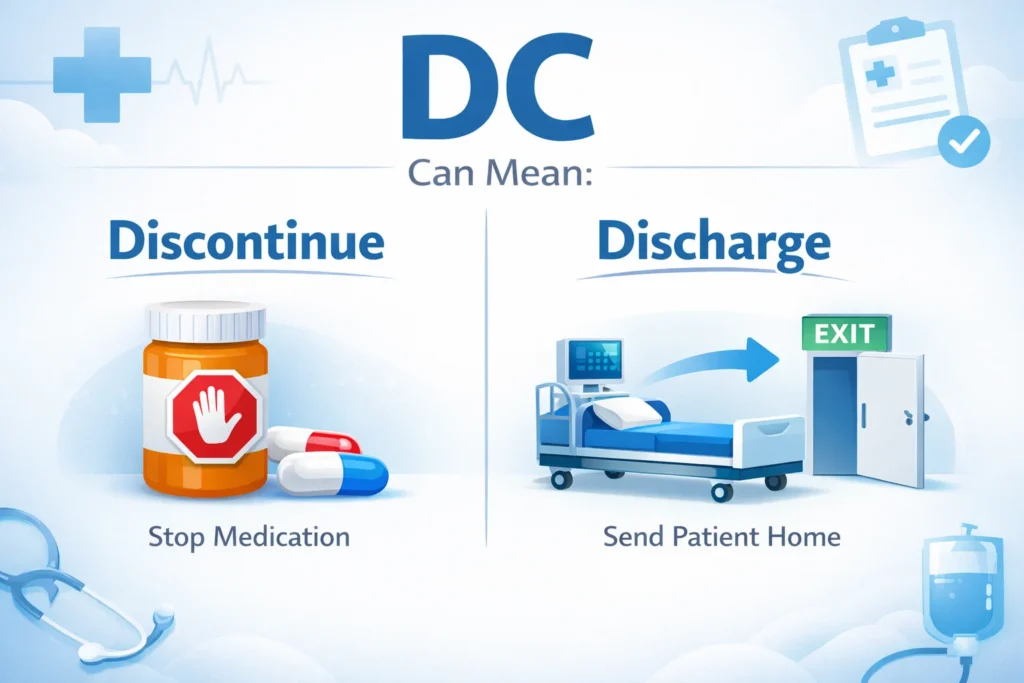
DC in medical terms most commonly means “Discontinue” or “Discharge,” depending on the context.
Discontinue (DC): To stop a medication, treatment, or procedure.
Discharge (DC): To release a patient from a hospital or healthcare facility.
This abbreviation is widely used in prescriptions, patient charts, and hospital notes, so understanding the context is key.
Medical abbreviations can be confusing even for people working in healthcare. One small abbreviation like “DC” can completely change meaning depending on where and how it’s used.
Imagine a doctor writes “DC meds” versus “Patient DC today.” One means stop medication, while the other means the patient is going home. Misunderstanding this could lead to serious mistakes.
In this guide, you’ll learn exactly what DC means in medical terms, how it’s used in real-life healthcare settings, and how to interpret it correctly like a pro.
Origin and Background of “DC” in Medical Language

Medical abbreviations like “DC” come from the need for speed and efficiency in clinical settings. Doctors, nurses, and pharmacists often write notes quickly, especially in emergencies.
- “Discontinue” comes from Latin roots meaning “to stop or break off.”
- “Discharge” refers to releasing a patient from care.
Over time, “DC” became a standard shorthand used in hospitals, clinics, and prescriptions worldwide.
Why Abbreviations Are Used
- Save time in fast-paced environments
- Reduce repetitive writing
- Standardize communication among healthcare professionals
However, because abbreviations can be misunderstood, some hospitals now encourage writing full words instead.
Common Meanings of DC in Medical Terms
1. DC = Discontinue
This is one of the most frequent meanings.
What it means:
Stop a medication, treatment, or medical order.
Examples:
- “DC antibiotics after 7 days.”
- “DC IV fluids.”
👉 In simple terms: Stop giving or using something.
2. DC = Discharge
Another very common meaning.
What it means:
A patient is being released from a hospital or healthcare facility.
Examples:
- “Patient DC today.”
- “Prepare discharge papers.”
👉 In simple terms: The patient is going home.
3. Less Common Meaning: Direct Current
In specific medical equipment contexts, DC can also mean Direct Current (electricity).
Example:
- “DC shock” (used in defibrillation)
👉 This is more technical and less common in everyday notes.
How Context Changes the Meaning of DC
Understanding context is everything with medical abbreviations.
Example Comparison
| Phrase | Meaning | Explanation |
|---|---|---|
| DC meds | Discontinue medications | Stop the medication |
| DC patient | Discharge patient | Send patient home |
| DC IV | Discontinue IV | Remove IV fluids |
| DC today | Discharge today | Patient leaving today |
👉 Same abbreviation, completely different meanings!
Real-World Usage in Healthcare Settings
In Hospitals 🏥
Doctors and nurses frequently use “DC” in:
- Patient charts
- Progress notes
- Discharge summaries
Example:
- “DC oxygen if stable.”
In Prescriptions 💊
Pharmacists may see:
- “DC previous medication before starting new one.”
In Nursing Notes 📝
Nurses document:
- “Patient DC home with family.”
Tone and Interpretation: Friendly vs Clinical Usage
Unlike casual language, “DC” is always clinical and professional. However, the tone can still vary depending on how it’s used.
Neutral/Professional Tone
- “DC medication after improvement.”
✔ Standard and clear
Urgent Tone
- “DC immediately!”
⚠ Indicates urgency
Routine Tone
- “Patient DC tomorrow.”
✔ Normal discharge planning
Examples of DC in Sentences
Discontinue Meaning
- “DC the painkillers once symptoms improve.”
- “Doctor advised to DC the antibiotics.”
- “Please DC IV fluids after 24 hours.”
Discharge Meaning
- “The patient will DC this evening 😊.”
- “He was DC after a full recovery.”
- “Prepare documents before DC.”
Comparison With Similar Medical Abbreviations
Medical shorthand can look similar, so it’s important to know the differences.
| Abbreviation | Meaning | Difference from DC |
|---|---|---|
| D/C | Same as DC | Just another format |
| Dx | Diagnosis | Identifies disease |
| Rx | Prescription | Treatment plan |
| Tx | Treatment | General care |
| Dx DC | Diagnosis & Discharge | Combined use |
👉 Tip: Always read the full sentence to avoid confusion.
Risks and Safety Concerns of Using “DC”
Because “DC” has multiple meanings, it can lead to medical errors if misunderstood.
Potential Risks
- Stopping medication too early ❌
- Discharging a patient incorrectly ❌
- Miscommunication between staff ❌
Why Some Hospitals Avoid It
Many healthcare systems now recommend:
- Writing “discontinue” instead of DC
- Writing “discharge” clearly
👉 Patient safety always comes first.
Alternative and Clearer Terms to Use
To avoid confusion, professionals often use full words.
Instead of DC (Discontinue)
- Stop medication
- Cease treatment
- End therapy
Instead of DC (Discharge)
- Release patient
- Send home
- Complete discharge
👉 These are clearer, especially for patients and non-medical readers.
Alternate Meanings of DC
While this article focuses on medical usage, “DC” can mean other things too:
- Direct Current (electricity)
- Washington, D.C. (location)
- Detective Comics (DC Comics)
👉 Context always determines meaning.
Usage Tips: How to Understand DC Correctly
Here’s how you can interpret “DC” without confusion:
1. Look at the Sentence
- “DC meds” → Discontinue
- “DC patient” → Discharge
2. Check the Setting
- Prescription → Likely discontinue
- Hospital note → Could be either
3. Ask for Clarification
If unsure, always confirm with a doctor or nurse.
Example Table: DC in Different Scenarios
| Scenario | Sentence | Meaning |
|---|---|---|
| Prescription | DC antibiotics | Stop medication |
| Hospital note | Patient DC today | Patient discharged |
| ICU setting | DC ventilator | Remove support |
| Routine care | DC IV fluids | Stop IV |
| Emergency | DC immediately | Urgent stop |
FAQs
1. What does DC stand for in medical prescriptions?
It usually means discontinue, instructing to stop a medication.
2. Does DC always mean discharge?
No. It can mean discontinue or discharge, depending on context.
3. What does “DC meds” mean?
It means stop taking medications.
4. What does “patient DC” mean?
It means the patient has been discharged from care.
5. Is DC still used in hospitals?
Yes, but many hospitals are moving toward clearer wording to avoid errors.
6. What is the difference between DC and D/C?
There is no difference they mean the same thing.
7. Why is DC considered risky?
Because it has multiple meanings, which can cause confusion and errors.
8. What should patients do if they see “DC”?
Ask a healthcare provider for clarification to avoid misunderstanding.
Conclusion:
Understanding what DC means in medical terms is important because this small abbreviation can have more than one meaning in healthcare settings. In most cases, DC stands for either “discontinue” (to stop a medication or treatment) or “discharge” (to release a patient from the hospital). The correct meaning depends entirely on the context in which it is used.
Because “DC” can refer to different actions, medical professionals always rely on surrounding notes or instructions to interpret it correctly. Misunderstanding the abbreviation could lead to confusion, which is why many hospitals now encourage writing the full words “discontinue” or “discharge” instead of using shorthand.
For patients and readers, the best approach is simple: pay attention to the context and ask for clarification if something isn’t clear. Clear communication helps ensure safe treatment and better understanding of medical instructions.
Discover More Related Articles:

Madison Taylor is an experienced content writer who focuses on researching and explaining word meanings, slang, and texting terms. She writes for meanvoro.com, creating clear and accurate to help readers understand language easily.