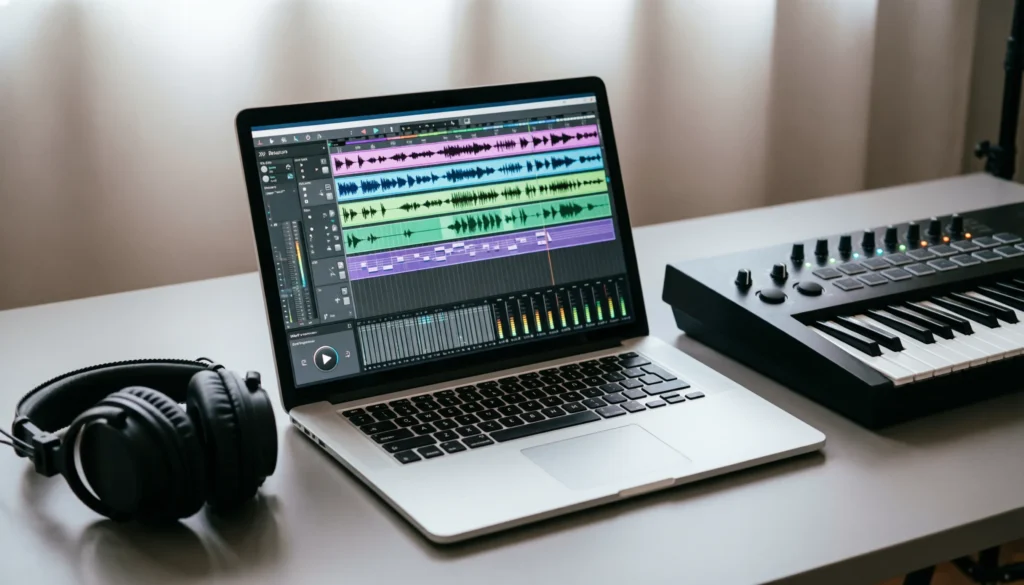
In music, DAW stands for Digital Audio Workstation, which is software used to record, edit, mix, and produce audio on a computer. A DAW allows musicians, producers, and sound engineers to create professional-quality music digitally.
If you’ve ever wondered how songs are made on a laptop, how beats are produced, or how podcasts are edited, the answer almost always involves a DAW.
Whether you are a beginner learning music production or a professional working in audio engineering, understanding what a DAW is and how it works is essential in today’s digital music world.
Origin and Evolution of the Term DAW
The term Digital Audio Workstation emerged in the late 1970s and 1980s when audio recording began shifting from analog tape machines to digital systems. Early digital recording systems were large and expensive, mainly used in professional studios.
As computer technology improved in the 1990s and 2000s, DAWs became:
- More affordable
- More powerful
- Accessible to home producers
- Industry standard for music production
Today, nearly every modern song, film soundtrack, podcast, or YouTube video has been edited or produced using a DAW.
The rise of bedroom producers and independent artists made DAWs even more popular. Now, you can produce an entire album using just a laptop and software.
What Does a DAW Actually Do?
A Digital Audio Workstation allows users to:
- Record vocals and instruments
- Edit audio recordings
- Arrange musical tracks
- Add virtual instruments
- Mix multiple sounds together
- Apply effects like reverb and compression
- Master songs for release
In simple terms, a DAW is a complete music production studio inside your computer.
Core Functions of a DAW
1. Recording Audio
You can record:
- Vocals
- Guitar
- Piano
- Drums
- Any instrument connected through an audio interface
Example:
A singer records their voice into a microphone connected to a DAW. The audio waveform appears on the screen for editing.
Tone: Neutral and professional use
2. Editing Audio
DAWs allow you to:
- Cut and trim audio
- Fix timing mistakes
- Correct pitch
- Remove background noise
Example:
If a vocalist sings slightly off-key, the producer can adjust the pitch inside the DAW.
Tone: Technical and precise
3. MIDI and Virtual Instruments
One powerful feature of modern DAWs is MIDI sequencing.
This allows you to:
- Program drums
- Play virtual pianos
- Create synth melodies
- Compose orchestral arrangements
Example:
A producer creates a full instrumental beat using only virtual instruments inside the DAW.
Tone: Creative and modern
4. Mixing and Effects
DAWs include tools to balance sound levels and apply effects like:
- Reverb
- Delay
- EQ
- Compression
Example:
A song may sound flat at first. After mixing in a DAW, it sounds polished and professional.
Tone: Professional studio context
Popular DAWs in Music Production
Here are some widely used Digital Audio Workstations:
| DAW Name | Common Use | Skill Level |
|---|---|---|
| Ableton Live | Electronic music, live shows | Beginner to Pro |
| FL Studio | Beat making, hip-hop | Beginner to Pro |
| Logic Pro | Professional music production | Intermediate |
| Pro Tools | Studio recording, film scoring | Professional |
| GarageBand | Beginner music creation | Beginner |
Each DAW has a different workflow, but they all perform the same core functions.
Real-World Usage of a DAW
In Music Production
Artists use DAWs to:
- Produce singles
- Create albums
- Mix and master tracks
In Film and Television
DAWs are used for:
- Sound design
- Dialogue editing
- Background scores
In Podcasting
Podcasters use DAWs to:
- Record interviews
- Remove noise
- Add intro music
In Live Performance
Some artists use DAWs to:
- Trigger backing tracks
- Control lighting and visuals
- Perform electronic sets
Comparison: DAW vs Traditional Recording Studio
| Feature | DAW (Digital) | Analog Studio |
|---|---|---|
| Equipment Size | Laptop-based | Large hardware setup |
| Cost | Affordable options available | Very expensive |
| Editing Flexibility | Extremely flexible | Limited physical editing |
| Portability | Highly portable | Fixed location |
| Learning Curve | Software-based learning | Hardware knowledge required |
Modern music production heavily favors DAWs because of their convenience and flexibility.
Alternate Meanings of DAW
Outside of music, DAW may sometimes refer to:
- A slang expression in informal speech
- Abbreviations in other industries
However, in music, DAW almost always means Digital Audio Workstation.
Common Mistakes About DAWs
- Thinking you need expensive gear to start
Many DAWs offer beginner-friendly versions. - Believing all DAWs sound different
The quality depends more on skill than software. - Confusing DAW with audio interface
A DAW is software, while an audio interface is hardware. - Assuming one DAW is “the best”
Each DAW is suited to different workflows and genres.
Polite and Professional Alternatives
Instead of saying “DAW” in formal writing, you can use:
- Digital Audio Workstation software
- Audio production software
- Music production platform
Example:
The engineer completed the mix using professional Digital Audio Workstation software.
FAQs
1. What does DAW stand for in music?
DAW stands for Digital Audio Workstation.
2. Do I need a DAW to make music?
Yes. If you are producing music digitally, you will use a DAW.
3. Is a DAW free?
Some DAWs offer free versions, while professional versions are paid.
4. What is the easiest DAW for beginners?
GarageBand and FL Studio are often considered beginner-friendly.
5. Can you record vocals in a DAW?
Yes. Recording audio is one of its main functions.
6. Is a DAW only for electronic music?
No. DAWs are used for all genres, including rock, pop, classical, and film scores.
7. Do professionals use DAWs?
Yes. Nearly all professional studios use DAWs.
8. Is a DAW hardware or software?
A DAW is software installed on a computer.
Conclusion:
A DAW, or Digital Audio Workstation, is the foundation of modern music production. It allows artists, producers, and engineers to record, edit, mix, and master music entirely within a computer.
From bedroom producers creating viral hits to professional studios producing film soundtracks, DAWs have transformed how music is made.
If you’re serious about making music, learning how to use a DAW is one of the most important skills you can develop.
Discover More Related Articles:

Ryan Thompson is an experienced content writer specializing in slang terms, texting abbreviations, and word meanings. He writes for meanvoro.com, where he creates accurate and easy-to-understand language content for readers.