📌Definition:
A closed circle in math is a filled-in dot on a number line that shows the endpoint is included in the solution.
It is commonly used when graphing inequalities and represents values that are part of the solution set.
If you’ve ever seen a number line with a solid dot at the end of a shaded line and wondered what it means you’re not alone.
In math, small symbols can completely change the meaning of an answer. One of the most common (and most misunderstood) is the closed circle.
Let’s break it down in a simple, clear way so you’ll never confuse it again.
Why Understanding a Closed Circle Matters
A closed circle might look tiny, but it carries big meaning. Whether you’re solving inequalities, working with interval notation, or studying algebra, understanding this symbol helps you:
- Graph inequalities correctly
- Interpret solutions accurately
- Avoid common test mistakes
- Understand interval notation
- Solve real-world math problems
Let’s explore exactly how it works.
What Is a Closed Circle in Math?
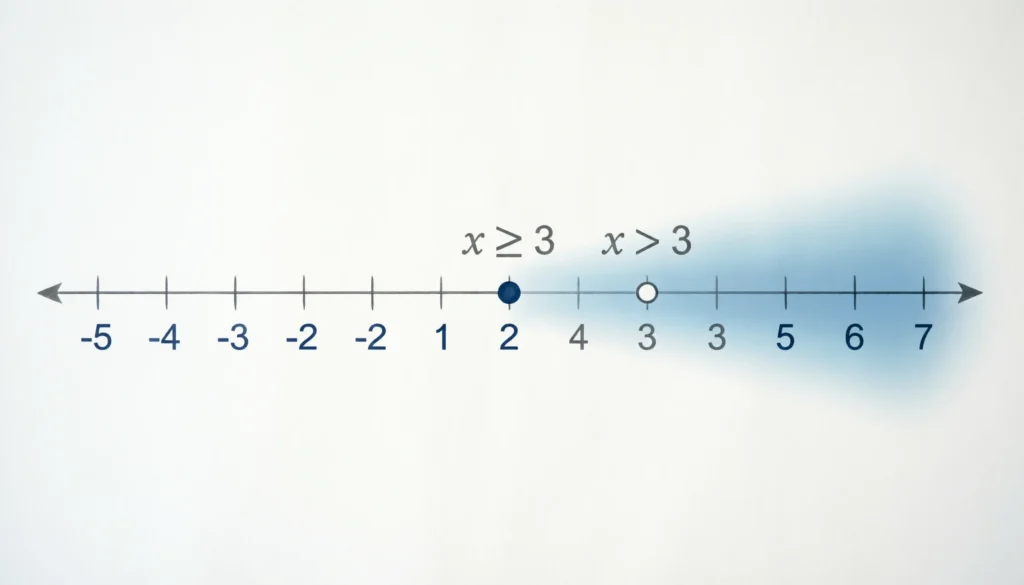
In mathematics, a closed circle (●) is used primarily on a number line to show that a specific value is included in a solution set.
You’ll most often see it when solving inequalities, such as:
- x ≤ 5
- x ≥ -2
If a number is included in the solution, we draw a closed (filled-in) circle on that number.
Closed Circle Symbol Meaning
When you see a filled-in dot, it means:
- “This number counts.”
- “This value is part of the answer.”
- “Include this point.”
Think of it as saying:
✔ Yes, this number belongs here.
Where Is a Closed Circle Used?
A closed circle appears in several math areas:
1️⃣ Inequalities
This is the most common use.
Example:
x ≤ 4
On a number line:
- Put a closed circle at 4
- Shade everything to the left
Why? Because 4 is included in the solution.
2️⃣ Graphing on a Number Line
When representing ranges, a closed circle tells you the boundary point is part of the range.
Example:
Temperature must be at least 32°F.
Mathematically:
T ≥ 32
You would:
- Place a closed circle at 32
- Shade to the right
Because 32 is allowed.
3️⃣ Interval Notation
Closed circles connect to brackets in interval notation.
If you see:
[2, 6]
The square brackets mean:
- 2 is included
- 6 is included
This matches closed circles at both endpoints.
Closed Circle vs Open Circle (Very Important)
Students often mix these up. Here’s a clear comparison:
| Feature | Closed Circle (●) | Open Circle (○) |
|---|---|---|
| Filled in? | Yes | No |
| Endpoint included? | Yes | No |
| Used with symbols | ≤ or ≥ | < or > |
| Interval notation | [ ] | ( ) |
| Meaning | Value counts | Value does not count |
Quick Memory Trick 🧠
- Closed = Complete = Included
- Open = Out = Not included
Simple and effective.
Examples of Closed Circle in Inequalities
Let’s go through clear examples.
Example 1: x ≥ 3
What it means:
All numbers greater than 3, including 3.
Graph:
- Closed circle at 3
- Shade to the right
Example 2: x ≤ -1
What it means:
All numbers less than or equal to -1.
Graph:
- Closed circle at -1
- Shade to the left
Example 3: -2 ≤ x ≤ 5
This is a compound inequality.
Graph:
- Closed circle at -2
- Closed circle at 5
- Shade between them
This shows the entire range is included.
Real-World Usage of Closed Circle
Closed circles aren’t just classroom symbols. They represent real-life limits.
Here are practical examples:
🎓 Grade Requirement
“To pass, you need at least 50%.”
Math:
x ≥ 50
50 is included — so we use a closed circle.
🚗 Speed Limit
“Maximum speed is 60 mph.”
Math:
x ≤ 60
You are allowed to drive 60 mph so 60 gets a closed circle.
💰 Age Restriction
“Must be 18 or older.”
Math:
x ≥ 18
18 is included closed circle.
Why Is It Called a “Closed” Circle?
The term “closed” comes from mathematical language about sets.
In set theory and topology:
- A closed set includes its boundary points.
- A closed circle visually shows that inclusion.
The filled dot represents a boundary that is part of the set.
So the name isn’t random it reflects deeper mathematical ideas.
Closed Circle in Set Notation
If we write:
{x | x ≥ 4}
This means:
All numbers x such that x is greater than or equal to 4.
When graphed:
- Closed circle at 4
- Shade right
Set notation, interval notation, and graphing all connect here.
Common Mistakes Students Make
Here are typical errors to avoid:
❌ Using an open circle for ≤ or ≥
Remember: “equal to” means included → closed circle.
❌ Forgetting to shade
The circle only marks the boundary. You must shade the direction.
❌ Mixing up interval brackets
[ ] means closed
( ) means open
Closed Circle in Advanced Math
As you move into higher-level math, closed circles appear in:
- Graphing piecewise functions
- Domain restrictions
- Calculus limit problems
- Absolute value inequalities
- Coordinate graph endpoints
For example:
f(x) =
2x + 1 if x ≤ 3
4 if x > 3
At x = 3:
- The first function includes 3 → closed circle
- The second excludes 3 → open circle
Closed Circle vs Brackets in Interval Notation
Here’s how they relate:
| Graph Symbol | Interval Notation | Meaning |
|---|---|---|
| ● at 2 | [2 | 2 included |
| ○ at 2 | (2 | 2 excluded |
| ● at 5 | 5] | 5 included |
| ○ at 5 | 5) | 5 excluded |
Example:
x ≥ 2
Interval form: [2, ∞)
Alternate Meanings of Closed Circle
While “closed circle” mainly refers to graphing inequalities in math, the phrase can also mean:
- A tight social group (informal usage)
- A cycle with no endpoints in geometry
- A closed geometric figure
However, in algebra and number line graphing, it specifically means the endpoint is included.
Friendly vs Formal Explanation
Friendly Version 🙂
A closed circle is just a filled-in dot that means, “Yep! This number is part of the answer.”
Formal Version 📘
A closed circle represents an inclusive boundary point in a solution set when graphing inequalities on a number line.
Visual Example Table
| Inequality | Closed or Open? | Why? | Graph Direction |
|---|---|---|---|
| x ≥ 7 | Closed | Includes 7 | Right |
| x > 7 | Open | Excludes 7 | Right |
| x ≤ -3 | Closed | Includes -3 | Left |
| x < -3 | Open | Excludes -3 | Lef |
FAQs
1. What does a closed circle mean on a number line?
A closed circle means the endpoint value is included in the solution.
2. When do you use a closed circle?
Use it when the inequality includes “equal to” (≤ or ≥).
3. What is the difference between open and closed circles in math?
Closed circles include the number. Open circles exclude it.
4. Does ≥ always use a closed circle?
Yes. “Greater than or equal to” means the number counts.
5. What does a closed circle mean in interval notation?
It corresponds to square brackets [ ] which indicate inclusion.
6. Can a closed circle appear in piecewise functions?
Yes. It shows which function includes the boundary value.
7. Is a closed circle the same as a bracket?
Visually different, but they represent the same idea of inclusion.
8. Why is it called closed instead of filled?
Because it represents a closed set, meaning it includes its boundary.
Conclusion
Understanding what a closed circle means in math is essential for working with inequalities, interval notation, and graphing. Though it may seem like a small symbol, it carries significant meaning.
Whenever you see a filled-in dot on a number line, think:
“This number is part of the solution.”
That simple shift in understanding can improve your accuracy in algebra, exams, and beyond.
Math is full of small details that matter and this is one of them.
Discover More Related Articles:

Madison Taylor is an experienced content writer who focuses on researching and explaining word meanings, slang, and texting terms. She writes for meanvoro.com, creating clear and accurate to help readers understand language easily.