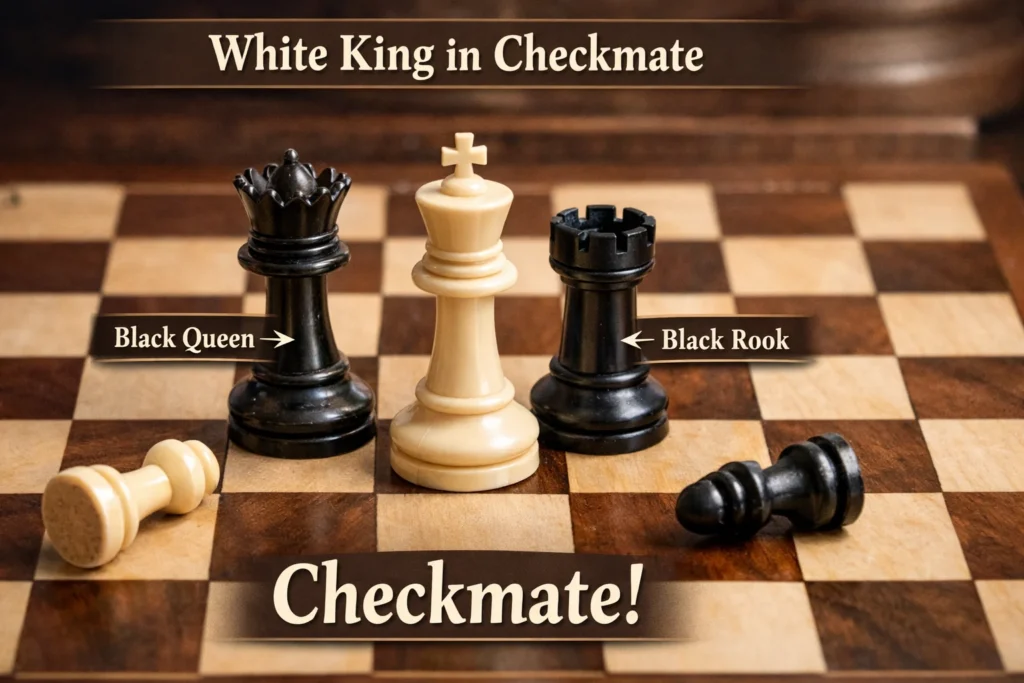
Checkmate is a chess term that refers to a situation where a player’s king is under direct attack (in “check”) and there is no legal move to remove the threat, resulting in the end of the game.
In simple terms, checkmate is when the king is trapped and the game is over.
If you have ever played chess or watched a game, you might have heard the word “checkmate” shouted at the end of a match. But what does checkmate really mean, and why is it so important in the game of chess?
Checkmate is more than just the end of a game. It’s the ultimate goal in chess, representing strategy, skill, and the final victory. Understanding checkmate helps beginners, casual players, and even advanced enthusiasts recognize winning patterns and appreciate the depth of chess.
This guide explains what checkmate means in chess, its origin, practical examples, common strategies, and real-life usage in a clear and friendly way.
Why Checkmate Is Important in Chess
Checkmate is the goal of every chess game. No matter how well you play, the game ends when one king is checkmated.
Key points about checkmate:
- It signals the end of the game
- Indicates victory for the attacking player
- Tests strategy, foresight, and planning
- Helps beginners understand attacking and defensive techniques
Without understanding checkmate, you cannot fully grasp chess strategy.
Origin of the Term Checkmate
The word checkmate comes from the Persian phrase “shah mat”, which means “the king is helpless” or “the king is dead.”
- Shah = king
- Mat = helpless or defeated
This phrase was adopted into Arabic as shah mat and eventually into European languages as checkmate. The term reflects the idea of a king being trapped with no escape, which is exactly what happens in a chess game.
How Checkmate Works in Chess
Checkmate happens when the following conditions are met:
- The king is under threat of capture (in check).
- The king cannot move to a safe square.
- No other piece can block or capture the threatening piece.
Once these conditions are met, the game ends immediately and the attacking player wins.
Common Checkmate Patterns
Many checkmate patterns have names and are commonly used in chess strategy. Here are a few:
| Checkmate Pattern | Description | Example |
|---|---|---|
| Back-rank mate | King trapped behind its own pawns on the back rank | Rook moves to deliver checkmate on the back rank |
| Scholar’s mate | Early-game checkmate using queen and bishop | 4-move checkmate targeting f7/f2 |
| Smothered mate | King surrounded by its own pieces, attacked by a knight | Knight delivers checkmate |
| Fool’s mate | Quickest possible checkmate in 2 moves | Exploits weak pawn moves near the king |
These patterns help players recognize opportunities and avoid traps.
Examples of Checkmate in Sentences
- White delivered checkmate with a queen and bishop.
- The game ended in checkmate after 35 moves.
- He tried to escape, but checkmate was inevitable.
Checkmate can also be used metaphorically to describe situations outside chess where someone is trapped or defeated.
Comparison: Check vs Checkmate
| Term | Meaning | Key Difference |
|---|---|---|
| Check | King is under threat but can escape | Game continues |
| Checkmate | King is trapped with no escape | Game ends, player loses |
Always remember: check is a warning, checkmate is final.
Polite or Alternative Phrases in Chess Commentary
While checkmate is standard, commentators and players sometimes use variations:
- Mate – Short version used in commentary
- The king is trapped – Descriptive way to explain checkmate
- Victory – General term for winning
Alternate or Metaphorical Meanings
Outside chess, checkmate can describe:
- A debate or argument where one person has a decisive advantage
Example:
- His response was brilliant, leaving her in checkmate during the debate.
FAQs
What does checkmate mean in chess?
Checkmate is when a player’s king is under attack and cannot escape, ending the game.
Is checkmate different from check?
Yes, check is a warning; checkmate is final and ends the game.
Can checkmate happen in one move?
Yes, if the king is trapped and cannot escape.
Who wins in checkmate?
The player delivering checkmate wins the game.
Is checkmate always caused by a queen?
No, any piece can deliver checkmate if the king cannot escape.
Can a player escape checkmate?
No, checkmate is by definition unavoidable.
How many moves does it take to achieve checkmate?
It depends on strategy; the fastest is 2 moves in Fool’s Mate.
Should beginners focus on checkmate patterns?
Yes, learning common checkmate patterns improves strategy and defense.
Practical Tips for Recognizing Checkmate
- Always scan for threats to your king
- Learn basic checkmate patterns like back-rank, scholar’s, and smothered mate
- Think two moves ahead to prevent or deliver checkmate
- Practice puzzles to improve recognition
Understanding checkmate improves both offense and defense in chess.
Conclusion
Checkmate is the ultimate goal in chess, signaling the end of a game and the victory of one player. It happens when a king is trapped with no escape, and understanding it is essential for every chess player.
By studying checkmate, you can:
- Recognize winning opportunities
- Improve your defensive strategy
- Understand chess tactics more deeply
- Apply the concept metaphorically in life or learning
Mastering checkmate patterns is a key step toward becoming a stronger, more confident chess player.
Discover More Related Articles:
- Lamentation Mean in the Bible: Why It Matters for Christians in 2026
- Adam Mean in the Bible: Symbolism, and Impact in 2026

Ryan Thompson is an experienced content writer specializing in slang terms, texting abbreviations, and word meanings. He writes for meanvoro.com, where he creates accurate and easy-to-understand language content for readers.