
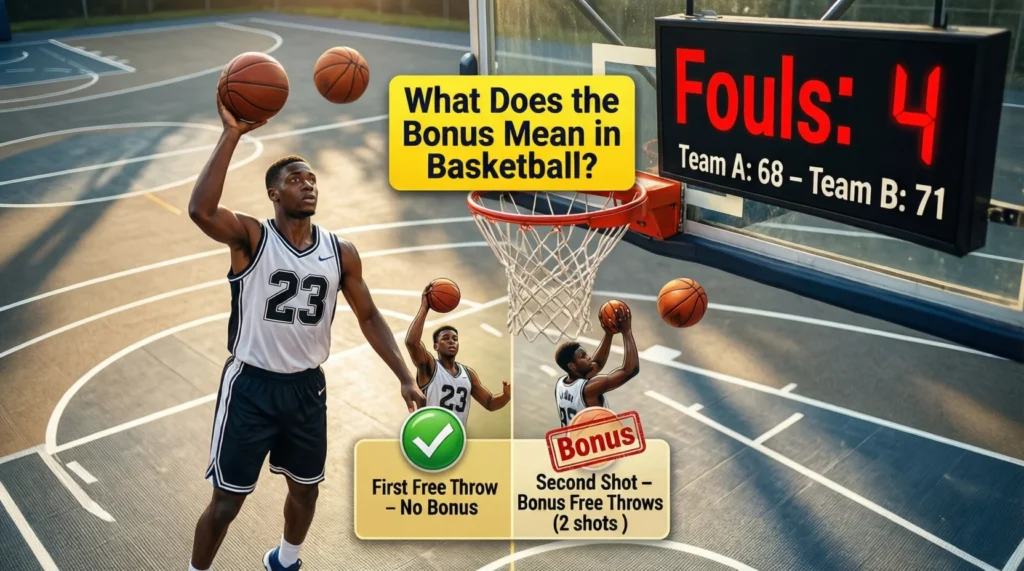
In basketball, the “bonus” refers to a situation where a team is awarded free throws automatically after the opposing team commits a certain number of fouls in a period.
This rule is designed to penalize teams for excessive fouling and can significantly impact the flow and score of a game.
Basketball is more than just shooting hoops and scoring points. It’s a game filled with rules, strategies, and unique terms that can confuse even seasoned fans. One term that often pops up during games and commentary is “the bonus.”
But what does the bonus mean in basketball, and why does it matter?
Understanding the bonus can help fans, players, and casual viewers make sense of free throws, foul strategies, and late-game tactics.
Origin of the Bonus Rule in Basketball
The bonus rule has its roots in the evolution of basketball’s rules aimed at fairness and maintaining game flow.
- Early Days: Initially, fouls only resulted in free throws if the player was shooting. Minor or strategic fouls often went unpunished.
- Introduction of the Bonus: To discourage repeated fouling to stop play, leagues introduced the bonus. By allowing free throws after a team exceeds a set number of fouls per period, it became a penalty that could influence strategy.
- NBA vs NCAA: While the NBA and NCAA use similar bonus concepts, the foul thresholds differ:
- NBA: Team enters the bonus after the fifth team foul in a quarter.
- NCAA Men’s: Bonus free throws start after the seventh team foul in a half, with “double bonus” after the tenth foul.
- NCAA Women’s: Bonus starts after the fifth foul in a quarter.
The bonus rule has become standard across professional and college basketball leagues worldwide.
How the Bonus Works in Basketball
The concept is simple but can seem tricky if you’re new to the game.
Step-by-Step Explanation
- Team Fouls Count: Each time a team commits a foul (excluding offensive fouls), it adds to the team’s total in that period.
- Reaching the Bonus: When a team exceeds the league-specific foul limit, every subsequent foul results in free throws for the opposing team.
- Single vs Double Bonus:
- Single Bonus: Typically one free throw is awarded, followed by a second if the first is successful (NCAA).
- Double Bonus: Two free throws are awarded automatically (common in college basketball after more fouls).
Examples of the Bonus in Real Games
Seeing the bonus in action makes it easier to understand.
| League | Foul Threshold | Bonus Type | Example Scenario |
|---|---|---|---|
| NBA | 5 fouls/quarter | Automatic 2 free throws | Team A commits 6th foul in Q2 → Team B shoots 2 free throws |
| NCAA Men | 7 fouls/half | Single Bonus | Team X commits 8th foul in 1st half → Player Y shoots 1 free throw (second if first made) |
| NCAA Men | 10 fouls/half | Double Bonus | Team X commits 11th foul → Player Y shoots 2 free throws automatically |
| NCAA Women | 5 fouls/quarter | Automatic 2 free throws | Team A hits 5th foul in Q3 → Team B awarded 2 free throws |
Example in context:
Imagine the score is tight in the final minutes. Team A is behind but keeps fouling to stop the clock. Once Team B is in the bonus, each foul gives them free points, which could swing the game dramatically.
Why the Bonus Is Important
The bonus isn’t just a rule—it’s a strategic element in basketball.
- Game Strategy: Teams may intentionally avoid fouling to prevent putting opponents in the bonus.
- End-of-Game Tactics: Trailing teams sometimes foul on purpose, even knowing the opponent is in the bonus, to stop the clock and regain possession.
- Impact on Scoring: Free throws from bonus situations can significantly affect the final score.
💡 Tip: Fans often hear commentators say, “They’re in the bonus now.” This signals that fouls will be more costly, and every free throw matters.
Comparison with Related Terms
The term “bonus” is often confused with other basketball concepts.
| Term | Difference from Bonus | Context |
|---|---|---|
| Free Throw | Any shot taken from the free-throw line, including bonus shots | Not all free throws are due to bonus; some are shooting fouls |
| Technical Foul | Awarded for unsportsmanlike behavior or rule violations | Results in 1 free throw, independent of team foul count |
| Double Bonus | A higher level of the bonus after exceeding a further foul threshold | Only applies in NCAA men’s basketball after 10 team fouls per half |
Understanding these distinctions ensures you don’t mix up free-throw opportunities caused by bonus vs other situations.
Alternate Meanings
Outside of basketball, “bonus” can mean extra benefits or rewards in everyday life:
- Workplace bonus: Additional pay for performance.
- Gaming bonus: Extra points, coins, or lives in a video game.
In basketball, however, it’s strictly tied to team fouls and free throws.
Polite and Professional Alternatives
When discussing basketball rules formally, you can use:
- “Team in the penalty”
- “Foul limit reached”
- “Eligible for free throws due to team fouls”
These alternatives are useful in coaching or analytical discussions.
FAQs
- Q: How many fouls before a team is in the bonus in the NBA?
A: Five team fouls per quarter. Every foul afterward gives the opponent two free throws. - Q: What is the double bonus in basketball?
A: In NCAA men’s basketball, it occurs after a team commits 10 fouls in a half, awarding two free throws automatically. - Q: Do offensive fouls count toward the bonus?
A: No. Only defensive or common fouls count. - Q: Can bonus rules vary between leagues?
A: Yes. NBA, NCAA, and international leagues have slightly different thresholds and rules. - Q: Does the bonus reset each period?
A: Usually, yes. In the NBA it resets every quarter; in NCAA it’s per half. - Q: Why is the bonus important for strategy?
A: Teams may change defense or foul intentionally based on bonus situations to manage scoring and time. - Q: Can a player be fouled in the bonus on a shooting attempt?
A: Yes. If a player is fouled while shooting, they get the usual free throws in addition to the bonus rules if applicable. - Q: What happens if a team exceeds fouls but the game ends?
A: Bonus rules apply immediately. Any foul after reaching the limit before game end results in free throws.
Conclusion
Understanding what the bonus means in basketball is essential for fans, players, and anyone looking to follow the game more closely. The bonus rule not only rewards teams for avoiding excessive fouls but also adds a strategic layer to every quarter or half.
Whether you’re watching the NBA, NCAA, or other leagues, knowing when a team is in the bonus can help you anticipate free throws, scoring opportunities, and potential momentum shifts.
By keeping track of team fouls, recognizing single versus double bonus situations, and understanding how the rule affects strategy, you can enjoy basketball with a deeper appreciation for its nuances.
Remember, the bonus is more than just free throws it’s a key element that can change the outcome of a game.
Search More Related Articles :
- BOT Mean in Baseball: Complete Guide for Fans & Players (2026)
- GIR Mean in Golf: Tips to Hit More Greens in Regulation (2026)

Ryan Thompson is an experienced content writer specializing in slang terms, texting abbreviations, and word meanings. He writes for meanvoro.com, where he creates accurate and easy-to-understand language content for readers.