

In television, syndication refers to the process of selling a TV show to multiple networks or local stations for broadcast after its original run, or sometimes directly without first airing on a major network.
Syndicated programs are distributed independently and can air in different time slots on different channels.
Have you ever wondered why certain TV shows seem to air everywhere? One channel shows it in the morning, another at night, and sometimes even internationally. That is syndication at work.
Syndication allows television shows to:
- Reach wider audiences
- Generate long-term revenue
- Extend a show’s lifespan
- Air in multiple markets simultaneously
For producers and networks, syndication can be more profitable than the original broadcast run. For viewers, it means enjoying favorite shows long after they first aired.
If you have ever watched reruns of a popular sitcom in the afternoon or late at night, you have experienced TV syndication in action. Syndication is one of the most important business models in the television industry and a major source of revenue for producers and studios.
Origin and Evolution of TV Syndication
The term “syndication” comes from the idea of forming a group or “syndicate” to distribute content across different buyers.
In early television history, major networks controlled most programming. However, independent stations needed content too. Production companies began selling shows directly to these stations, creating what became known as syndication.
Over time, syndication became a powerful revenue model. Classic sitcoms and dramas gained second lives through reruns, often becoming even more profitable than their original broadcasts.
Types of TV Syndication
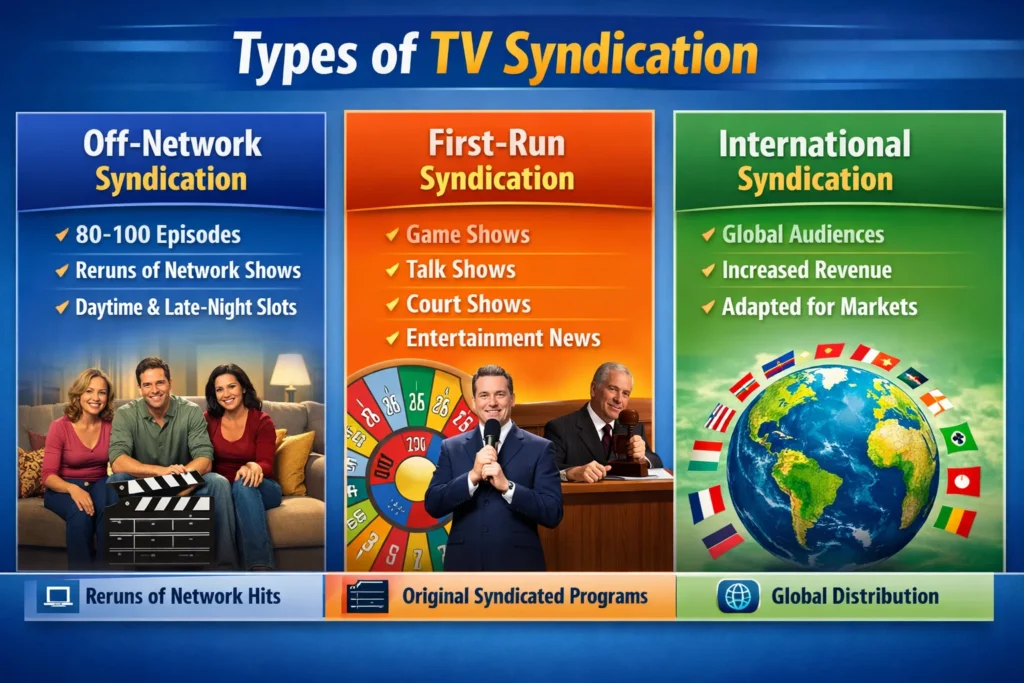
There are three main types of television syndication.
1. Off-Network Syndication
This happens when a show that originally aired on a major network is later sold to other stations for reruns.
Example:
A popular sitcom airs for five seasons on a network. After it builds a large episode library, it is sold to local stations for daytime reruns.
Common characteristics:
- Usually requires around 80 to 100 episodes
- Includes reruns of previously aired content
- Often airs during daytime or late-night slots
2. First-Run Syndication
This refers to shows produced specifically for syndication and not tied to a major network.
Examples include:
- Game shows
- Talk shows
- Court shows
- Entertainment news programs
These programs are sold directly to local stations from the start.
3. International Syndication
Shows are licensed to broadcasters in other countries.
This allows programs to:
- Reach global audiences
- Increase revenue streams
- Adapt content to different markets
How Syndication Works in Practice
Here is a simplified breakdown of how the process works:
- A production company creates a TV show
- The show airs on a network or is created for syndication
- The production company sells rights to multiple stations
- Stations choose time slots independently
- Revenue is generated through advertising
Because different stations purchase the show, it may air at different times depending on the market.
Examples of Syndication in Real Life
Here are examples showing how syndication works in context:
| Scenario | Example | Explanation |
|---|---|---|
| Reruns | A sitcom airs at 3 PM on a local channel | Off-network syndication |
| Game Show | A daily quiz show airs on different stations | First-run syndication |
| Global Distribution | A drama series airs in multiple countries | International syndication |
| Late Night | Old episodes shown at midnight | Revenue from reruns |
Why Syndication Is So Profitable
Syndication can generate long-term income because:
- Episodes can be aired repeatedly
- Advertising revenue continues
- Shows gain new audiences
- Licensing fees add up over time
Some shows earn millions through syndication deals alone. In many cases, syndication revenue surpasses original broadcast earnings.
Syndication vs Streaming
In the modern era, streaming platforms have changed distribution. However, syndication still plays an important role.
| Feature | Syndication | Streaming |
|---|---|---|
| Distribution | Sold to stations | Hosted on digital platforms |
| Time Slot | Fixed broadcast time | On-demand viewing |
| Revenue | Advertising and licensing | Subscriptions and ads |
| Flexibility | Scheduled | Viewer-controlled |
While streaming allows viewers to watch anytime, syndication remains important for traditional broadcast television and advertising markets.
Common Programs That Use Syndication
Syndicated content often includes:
- Sitcom reruns
- Talk shows
- Game shows
- Courtroom programs
- Reality shows
- Entertainment news
These formats perform well because they can be watched independently without following a strict storyline.
Polite and Professional Alternatives
In professional media discussions, “syndication” may also be described as:
- Content distribution
- Broadcast licensing
- Program licensing
- Secondary market distribution
These terms are often used in industry contracts and media business reports.
FAQs
- What does syndication mean in TV?
It means selling a TV show to multiple stations or networks for broadcast. - What is off-network syndication?
It is when a show that originally aired on a major network is sold for reruns elsewhere. - What is first-run syndication?
It refers to shows produced specifically to air independently on local stations. - Why is syndication important?
It helps shows earn long-term revenue and reach wider audiences. - Do all TV shows get syndicated?
No. Shows usually need enough episodes and popularity to qualify. - Is syndication still relevant today?
Yes. It remains a major revenue source alongside streaming. - How many episodes are needed for syndication?
Typically around 80 to 100 episodes for off-network deals. - Does syndication increase a show’s popularity?
Yes. Reruns often introduce shows to new audiences.
Practical Tips for Understanding TV Syndication
- Look at your local TV schedule to spot reruns
- Notice how the same show airs on different channels
- Understand that time slots vary by market
- Remember that advertising drives much of syndication revenue
Syndication is both a business strategy and a distribution method that extends a program’s lifespan.
Conclusion
Syndication in television refers to distributing a TV show to multiple networks or stations for broadcast, often after its original run or directly as a first-run program. It allows producers to maximize revenue, extend audience reach, and give shows a long-lasting presence in the media landscape.
Understanding syndication helps you see television not just as entertainment, but as a carefully structured business ecosystem.
Discover More Related Articles:
- JOI Mean in Porn | Understanding the Adult Content Slang Term In 2026
- The Root Tele Mean in Television | Understanding the Word’s Origin In 2026
- Closed Circle Mean in Math |The Symbol Most Students Misunderstand In 2026

Ryan Thompson is an experienced content writer specializing in slang terms, texting abbreviations, and word meanings. He writes for meanvoro.com, where he creates accurate and easy-to-understand language content for readers.