In music, rhythm refers to the pattern of sounds and silences in time. It is the arrangement of note durations, beats, and accents that give music its structure, flow, and movement.
Rhythm is essential in defining a piece of music, making it feel lively, steady, or expressive.
Rhythm is often called the heartbeat of music because it drives the flow and energy of a piece. Without rhythm, melodies and harmonies would feel static and directionless.
From the steady pulse of a march to the syncopated beats of jazz or the complex patterns in African drumming, rhythm provides structure, emotion, and engagement. Learning rhythm helps musicians stay in time, create dynamics, and connect with audiences.
Understanding rhythm is fundamental for musicians, composers, and listeners alike. It shapes how music is performed, felt, and interpreted, and it is one of the core elements that distinguishes different genres, styles, and cultures in music.
Origin and Definition of Rhythm
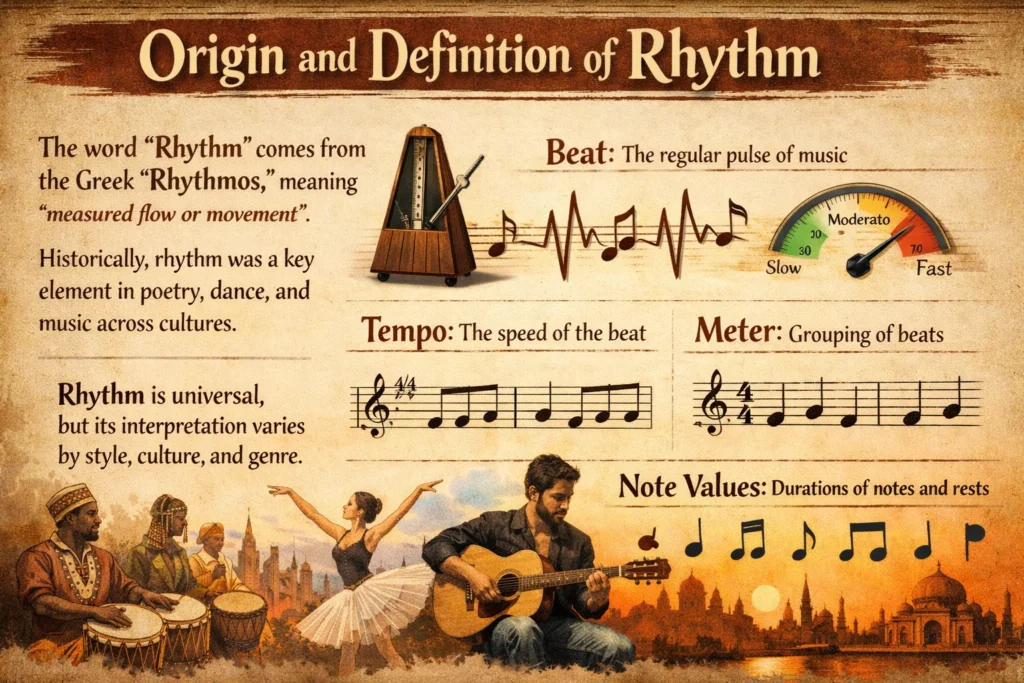
The word “rhythm” comes from the Greek term “rhythmos,” meaning “measured flow or movement.” Historically, rhythm was recognized as a fundamental element in poetry, dance, and music across cultures.
In Western music theory, rhythm is classified based on:
- Beat: The regular pulse of music
- Tempo: The speed of the beat
- Meter: Grouping of beats into patterns (e.g., 4/4, 3/4)
- Note values: Durations of notes and rests
Rhythm is universal, but its interpretation varies by style, culture, and genre.
How Rhythm Works in Music
Rhythm is not just about speed; it is about patterns of timing, accents, and repetition. Musicians use rhythm to:
- Coordinate instruments and voices
- Create tension and release
- Convey mood and emotion
- Engage listeners and dancers
Key Components of Rhythm
| Component | Definition | Example |
|---|---|---|
| Beat | The steady pulse in music | The consistent “tick-tock” in a metronome |
| Meter | Grouping of beats | 4/4, 3/4, 6/8 time signatures |
| Tempo | Speed of the music | Allegro (fast), Adagio (slow) |
| Note values | Duration of sounds | Whole note, half note, quarter note |
| Syncopation | Off-beat accents | Jazz or funk emphasizing weak beats |
Types of Rhythm in Music
Rhythm can vary widely depending on genre and style:
- Simple Rhythm: Regular and predictable patterns (e.g., pop songs, marches)
- Complex Rhythm: Irregular or syncopated patterns (e.g., jazz, progressive rock)
- Polyrhythm: Two or more contrasting rhythms played simultaneously (e.g., African drumming, Latin music)
- Free Rhythm: No strict beat, used in ambient or experimental music
Examples of Rhythm in Context
| Genre | Example | Description |
|---|---|---|
| Pop | “We Will Rock You” by Queen | Simple, strong, repeated beat |
| Jazz | Swing rhythms in a jazz combo | Syncopation and off-beat emphasis |
| Classical | Beethoven’s 5th Symphony | Driving, structured rhythmic motifs |
| African Drumming | Traditional djembe patterns | Polyrhythms with interlocking beats |
Pro tip: Clapping or tapping along with music helps develop a natural sense of rhythm.
Rhythm vs. Tempo vs. Beat
These terms are related but different:
| Term | Definition | Key Difference |
|---|---|---|
| Rhythm | Pattern of sounds and silences | Shape and flow of music over time |
| Beat | Regular pulse | Foundation of rhythm, like a clock |
| Tempo | Speed of the beat | Fast or slow pace of the music |
Understanding the difference ensures you can read, perform, and analyze music accurately.
Importance of Rhythm in Music
Rhythm plays a crucial role in:
- Performance: Guides timing for musicians and dancers
- Composition: Shapes structure, phrasing, and dynamics
- Listening Experience: Creates movement, tension, and resolution
- Genre Identification: Helps distinguish jazz, classical, hip-hop, and rock
For example, the syncopated rhythm in jazz creates swing and groove, while the steady 4/4 rhythm in pop is easy to follow and dance to.
Common Rhythm Notation Symbols
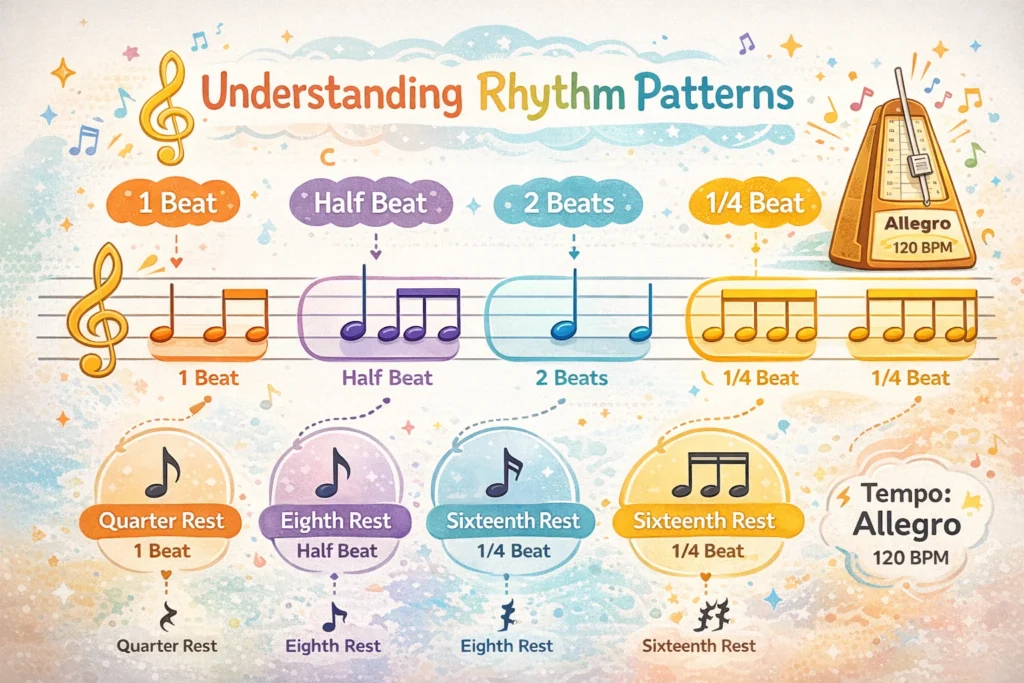
Musicians read rhythm using note and rest symbols. Common values include:
| Symbol | Name | Duration |
|---|---|---|
| 𝅝 | Whole note | 4 beats |
| 𝅗𝅥 | Half note | 2 beats |
| 𝅘𝅥 | Quarter note | 1 beat |
| 𝅘𝅥𝅮 | Eighth note | ½ beat |
| 𝄽 | Rest | Silence of corresponding duration |
Counting and practicing these note values is essential for mastering rhythm.
FAQs
- What does rhythm mean in music?
Rhythm is the pattern of sounds and silences in time, giving music structure and movement. - How is rhythm different from tempo?
Tempo is the speed of the beat, while rhythm is the pattern of notes and rests over time. - What is syncopation?
Syncopation emphasizes weak beats or off-beat notes to create interest. - What are polyrhythms?
Polyrhythms occur when multiple rhythms are played simultaneously, often in African or Latin music. - Why is rhythm important?
Rhythm provides structure, helps musicians stay in time, and engages listeners. - Can rhythm exist without melody?
Yes, percussion instruments often carry rhythm without melodic elements. - What is a beat?
A beat is the basic pulse or “heartbeat” of a piece of music. - How can I improve my sense of rhythm?
Practice clapping, tapping, or playing along with a metronome or music tracks.
Practical Tips for Developing Rhythm
- Use a metronome to practice steady beats
- Clap or tap different rhythmic patterns
- Listen actively to different genres to feel varying rhythms
- Practice syncopation and polyrhythms to challenge timing skills
- Play rhythm games or percussion instruments for hands-on learning
Conclusion
Rhythm is a fundamental element of music that gives life, energy, and structure to every performance. From simple beats in pop songs to complex polyrhythms in jazz and world music, rhythm shapes how we experience sound.
- Pro tip: Practicing rhythm improves musicality, timing, and coordination
- Practice tip: Start with basic rhythms and gradually explore complex patterns for mastery
Understanding rhythm allows musicians and listeners to connect deeply with music and enjoy the emotional and physical experience it provides.
Discover More Related Articles:
- JOI Mean in Porn | Understanding the Adult Content Slang Term In 2026
- The Root Tele Mean in Television | Understanding the Word’s Origin In 2026
- Closed Circle Mean in Math |The Symbol Most Students Misunderstand In 2026

Ryan Thompson is an experienced content writer specializing in slang terms, texting abbreviations, and word meanings. He writes for meanvoro.com, where he creates accurate and easy-to-understand language content for readers.