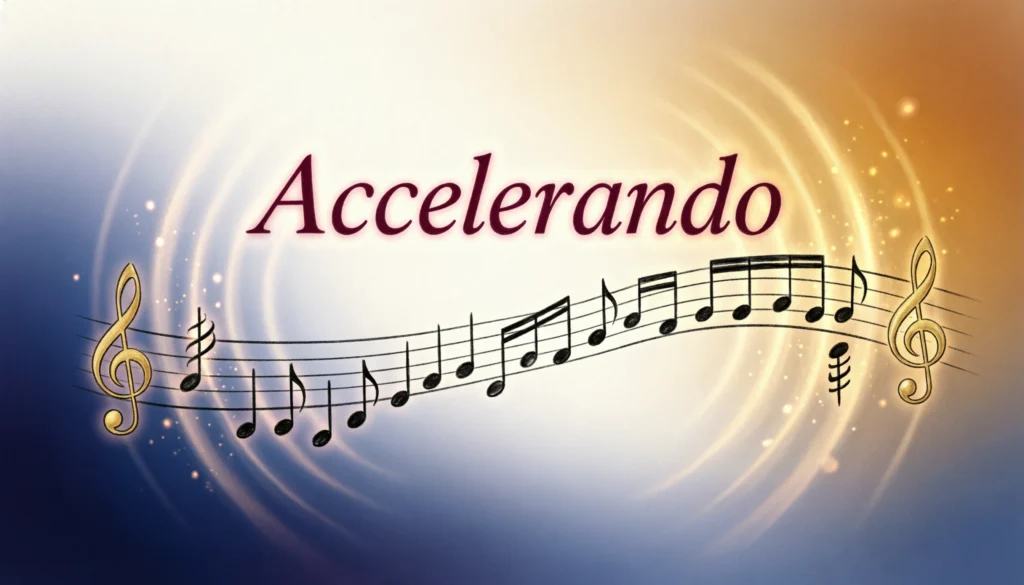
“Accelerando” is an Italian musical term that means “gradually speeding up”. It instructs musicians to increase the tempo of a piece progressively, creating excitement, tension, or momentum in the music.
Whether you’re reading sheet music, learning an instrument, or composing your own music, understanding accelerando helps bring dynamic expression to performances. It is commonly used in classical, jazz, and modern music to guide tempo changes with precision.
Origin of “Accelerando”
The word accelerando comes from Italian, the traditional language of music notation.
- Latin root: accelerare → “to hasten” or “to quicken”
- Italian suffix: -ando → indicating a continuous action
So accelerando literally means “becoming faster”. Italian terms like this are standard in music notation because Italian musicians were pioneers in formalizing classical music theory during the Renaissance and Baroque periods.
Popularity and Real-World Usage
Accelerando is widely used in various musical contexts:
- Classical music: Composers like Beethoven, Chopin, and Mozart used accelerando to build tension toward climaxes.
- Jazz and modern music: Band leaders or sheet music may indicate accelerando to increase excitement during a solo or transition.
- Film and game scores: Composers use gradual tempo increases to heighten suspense or intensity.
Its popularity persists because it allows performers to convey emotion dynamically and naturally, instead of abrupt tempo changes that might feel mechanical.
How “Accelerando” Works in Music
Musicians interpret accelerando by gradually increasing the speed over a defined section of the piece.
- Tempo indication: Usually placed above the staff in sheet music
- Duration: Until the next tempo marking (e.g., a tempo, ritardando, or a specific metronome marking)
- Effect: Builds excitement, energy, or forward momentum
Quick Tip: Accelerando doesn’t have a fixed speed. The performer must gradually increase tempo in a way that feels natural for the piece and context.
Examples of “Accelerando” in Sheet Music
| Example | Musical Context | Effect |
|---|---|---|
| Beethoven’s Symphony No. 5 | In the first movement, a short accelerando builds dramatic tension before the next motif | Creates anticipation and excitement |
| Chopin’s Nocturne in E-flat Major | In a flowing passage, accelerando adds momentum toward a lyrical climax | Smoothly drives emotional intensity |
| Jazz ensemble riff | During a solo, accelerando gradually speeds up to energize the performance | Engages the listener and increases intensity |
Comparison With Related Terms
| Term | Meaning | Difference from Accelerando |
|---|---|---|
| Ritardando (rit.) | Gradually slowing down | Opposite of accelerando |
| Stringendo | Gradually faster, often with tension | Similar to accelerando, but more urgent and dramatic |
| Tempo primo | Return to the original tempo | Marks end of accelerando or other tempo changes |
| Più mosso | More motion / slightly faster | Slight tempo change, not necessarily gradual |
Quick Tip: In contrast to ritardando, accelerando increases energy and urgency in music.
Alternate Meanings and Usage
While accelerando is primarily a musical instruction:
- Figurative use: Some writers or music critics may use “accelerando” metaphorically to describe a process that speeds up gradually, such as narrative pacing in a film.
- Instrument-specific application: Pianists, violinists, and orchestral musicians all interpret accelerando differently depending on technique and instrument capabilities.
Polite and Professional Alternatives in Music Notation
In case you want more descriptive instructions:
- “Gradually faster” → English alternative for beginner-friendly sheet music
- “Increase tempo steadily” → Clear verbal instruction in rehearsal
- “Speed up gradually” → Common phrasing for students and ensembles
These alternatives make accelerando easier to understand for beginners without losing musical precision.
FAQs
- What does accelerando mean in music?
It means gradually increasing the tempo of a musical passage. - How is accelerando indicated in sheet music?
Usually written above the staff, sometimes abbreviated as accel.. - Is accelerando the same as speeding up suddenly?
No, it is gradual, not sudden. Sudden speed changes are called a tempo or subito allegro. - How long should accelerando last?
Until the next tempo marking or the composer’s specified end. - Is accelerando used in all music genres?
Yes, classical, jazz, pop, and film music all use it. - Can a conductor control accelerando in an orchestra?
Absolutely, the conductor signals the gradual tempo increase through gestures and cues. - What is the difference between accelerando and stringendo?
Both mean gradually faster, but stringendo implies urgency and often dramatic tension. - Can beginners play accelerando correctly?
Yes, with practice, listening, and careful observation of tempo markings, beginners can interpret it naturally.
Practical Tips for Musicians
- Listen carefully: To maintain musicality, let the increase feel natural.
- Use a metronome cautiously: Helpful for practice, but live music requires flexibility.
- Communicate in ensembles: Ensure everyone interprets the tempo increase similarly.
- Combine with dynamics: Pairing accelerando with crescendos enhances the effect.
- Mark the sheet music: Note the beginning and end of accelerando sections clearly for consistency.
Conclusion
Accelerando is a powerful musical tool that gives life, energy, and drama to compositions. By gradually increasing the tempo, musicians create excitement, tension, and forward motion in performances. Whether you are a beginner or professional, understanding accelerando is essential for expressive and dynamic music interpretation.
Mastering accelerando lets musicians communicate emotion and narrative through tempo, making performances feel alive and engaging.
Discover More Related Articles:
- Lamentation Mean in the Bible: Why It Matters for Christians in 2026
- Adam Mean in the Bible: Symbolism, and Impact in 2026

Ryan Thompson is an experienced content writer specializing in slang terms, texting abbreviations, and word meanings. He writes for meanvoro.com, where he creates accurate and easy-to-understand language content for readers.