
RIF stands for Reduction in Force.
It is a business and HR term used to describe the permanent or temporary elimination of positions within a company, usually due to financial constraints, restructuring, or efficiency improvements.
In simple terms, RIF refers to layoffs or staff reductions in a company.
If you’ve ever seen the term RIF on an HR notice, company email, or business report, you might have wondered what it means and how it affects employees. In business, RIF is an important concept that relates to workforce management, company restructuring, and career planning.
Understanding what RIF means in business is essential not only for managers and HR professionals but also for employees, job seekers, and anyone involved in organizational operations.
In business communications, you may have seen the acronym RIF on HR documents, company announcements, or financial reports. For employees and managers alike, understanding what RIF means in business is essential, as it relates to workforce management and organizational changes.
Why RIF Is Important in Business
RIF is a critical concept because it directly affects employees, company operations, and long-term planning. Understanding RIF helps managers:
- Communicate changes transparently
- Plan workforce adjustments efficiently
- Avoid legal or compliance issues
- Support affected employees through transitions
For employees, understanding RIF helps interpret company announcements and plan career decisions proactively.
Origin and Usage of RIF
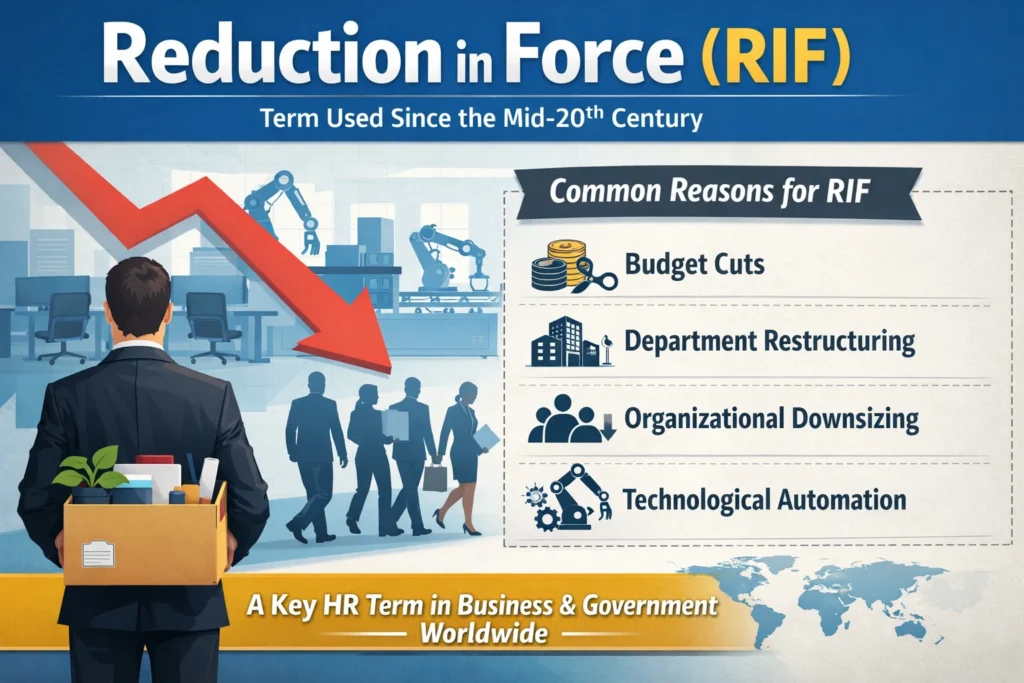
The term Reduction in Force has been used in business and government sectors since the mid-20th century. It became common as organizations standardized HR policies to address:
- Budget cuts
- Department restructuring
- Organizational downsizing
- Technological automation reducing staffing needs
RIF is now a formal HR term used globally, especially in corporate and government settings.
Core Meaning of RIF
At its core, a RIF involves reducing the number of employees. However, it is different from resignations or terminations for cause:
- Resignation: Employee leaves voluntarily
- Termination for cause: Employee is let go due to performance or misconduct
- RIF: Employee is let go due to business or organizational needs, not personal performance
Types of RIF
RIF can occur in several ways:
1. Permanent RIF
Positions are eliminated permanently, and the company does not plan to refill them.
Example:
- A department is downsized, and certain roles are removed permanently.
2. Temporary RIF
Positions are temporarily eliminated, often with plans to rehire later.
Example:
- Seasonal workforce reduction in retail or manufacturing.
3. Voluntary RIF
Employees are offered incentives to leave voluntarily as part of a reduction plan.
Example:
- Early retirement packages or voluntary separation offers.
Real-Life Examples of RIF in Business
- Tech company downsizing: A tech firm eliminates 100 positions due to budget cuts.
- Government RIF: A department reduces staff because of funding limitations.
- Corporate restructuring: Positions in redundant departments are removed permanently.
In all these cases, RIF is used officially in HR documents and employee communications.
Common Expressions Using RIF
- RIF notice – A formal notification given to affected employees
- RIF planning – The process of determining which positions are eliminated
- RIF strategy – A business plan for managing workforce reduction efficiently
Comparison RIF vs Layoff vs Downsizing
| Term | Meaning | Key Difference |
|---|---|---|
| RIF | Reduction in Force | Formal HR term; usually permanent or temporary |
| Layoff | Employee temporarily or permanently removed | Often used casually; may be short-term |
| Downsizing | Company-wide reduction in staff | Focused on organizational efficiency, may include RIF |
RIF is more official and structured, whereas “layoff” can be used informally.
Polite or Professional Alternatives
When discussing RIF with sensitivity, professionals often use:
- Workforce reduction
- Staff adjustment
- Organizational restructuring
Example:
- Direct: “You are impacted by RIF”
- Polite: “You are affected by the company’s workforce adjustment”
Alternate Meanings or Confusions
Outside business HR, RIF can also mean:
- Rest in Fire – internet slang, gaming context
- Routing Information Field – technical or telecom term
In business or HR contexts, RIF always refers to Reduction in Force.
FAQs
Meaning of RIF in business?
RIF stands for Reduction in Force, referring to staff reductions due to business needs.
How does RIF differ from layoffs?
RIF is a formal HR term, while layoffs are often short-term or informal.
Why companies implement RIF?
Companies use RIF to reduce costs, improve efficiency, or restructure departments.
Are RIFs permanent?
RIFs can be permanent, temporary, or voluntary, depending on the plan.
What is a RIF notice?
A RIF notice is an official document informing employees of workforce reductions.
Do employees receive severance in a RIF?
Often yes, depending on company policy and local labor laws.
Can RIF affect all departments?
Yes, but typically it targets specific areas impacted by restructuring or budget cuts.
Should employees plan for a RIF?
Yes, understanding RIF helps employees make career decisions proactively.
Practical Tips for Handling or Understanding RIF
- Read RIF notices carefully
- Understand company policies and severance packages
- Maintain professional communication with HR
- Plan career steps proactively
- Seek legal or professional advice if needed
Conclusion
RIF in business stands for Reduction in Force, a formal HR term used to describe workforce reductions. Typically, a RIF can be permanent, temporary, or voluntary, and it is driven by business needs rather than individual performance.
Understanding RIF helps employees:
- Interpret HR communications
- Prepare for changes in employment
- Navigate career transitions
- Stay informed about company restructuring
For businesses, RIF ensures organizational efficiency, transparency, and compliance.
Discover More Related Articles:
- JOI Mean in Porn | Understanding the Adult Content Slang Term In 2026
- The Root Tele Mean in Television | Understanding the Word’s Origin In 2026
- Closed Circle Mean in Math |The Symbol Most Students Misunderstand In 2026

Ryan Thompson is an experienced content writer specializing in slang terms, texting abbreviations, and word meanings. He writes for meanvoro.com, where he creates accurate and easy-to-understand language content for readers.