
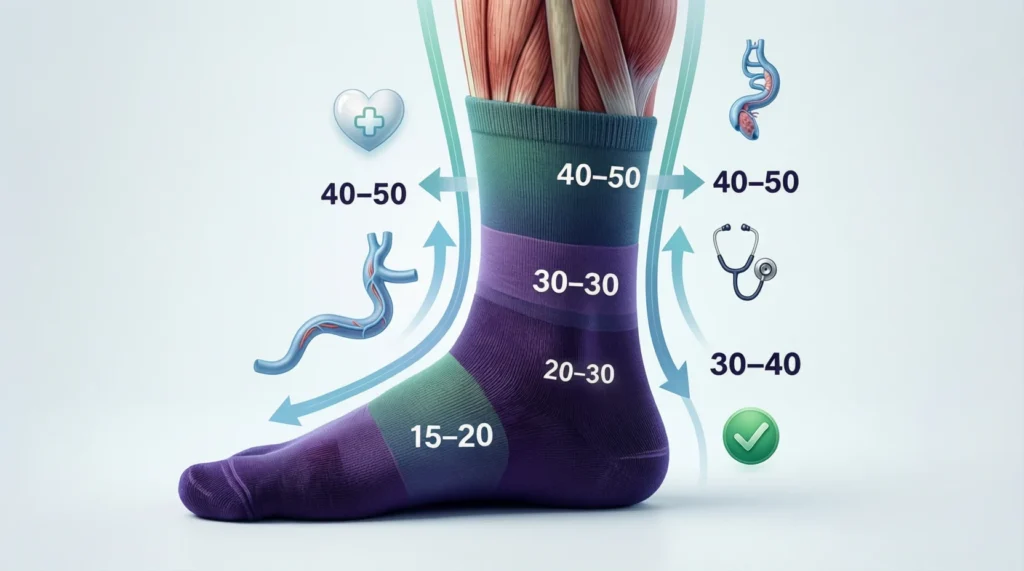
In compression socks, MMHg stands for millimeters of mercury, a unit of measurement used to indicate pressure. It tells you how much compression the sock applies to your legs to improve blood circulation, reduce swelling, and prevent varicose veins.
Understanding MMHg is essential when choosing compression socks for medical, athletic, or everyday use, ensuring you get the right level of support for your needs.
Origin and Popularity of MMHg
The term MMHg originates from medical and scientific measurement standards. It literally means the height of a column of mercury in millimeters, a traditional way to measure blood pressure.
In the context of compression socks, it has been adopted to quantify the amount of pressure the socks exert on your legs. Compression levels are standardized to help healthcare providers and consumers select the right product:
- 15–20 mmHg: Mild compression, for everyday comfort
- 20–30 mmHg: Moderate compression, for mild swelling or travel
- 30–40 mmHg: Firm compression, for serious circulation issues
- 40–50 mmHg: Extra-firm, usually prescribed by doctors
MMHg is popular in both medical and fitness communities, as it gives a precise, measurable standard for the pressure applied by compression garments.
How MMHg Is Used in Compression Socks
1. Understanding Compression Levels
Compression socks are categorized by MMHg ratings, which indicate how tight the socks are at the ankle and how they gradually loosen toward the calf or thigh (gradient compression).
Example:
- 20–30 mmHg socks: Tightest at the ankle, gradually looser at the calf. Ideal for travel, mild varicose veins, or post-pregnancy leg swelling.
2. Medical Applications
Doctors often recommend compression socks with a specific MMHg to manage conditions like:
- Varicose veins
- Chronic venous insufficiency
- Deep vein thrombosis (DVT) prevention
- Post-surgical recovery
Example:
- Post-surgery patients may wear 30–40 mmHg compression socks for a few weeks to improve blood flow.
3. Athletic and Everyday Use
Athletes and people on their feet all day also use compression socks to:
- Reduce muscle fatigue
- Improve circulation
- Minimize swelling after long flights or standing
Example:
- Runners may wear 15–20 mmHg socks for recovery after training sessions.
Example
| MMHg Rating | Pressure Level | Best For | Tone/Usage |
|---|---|---|---|
| 15–20 mmHg | Mild | Everyday use, mild swelling | Casual/Comfort |
| 20–30 mmHg | Moderate | Varicose veins, travel, mild edema | Medical/Preventive |
| 30–40 mmHg | Firm | Severe varicose veins, post-surgery | Medical |
| 40–50 mmHg | Extra-Firm | Severe venous disorders (prescribed) | Medical |
Comparison With Similar Measurements
| Measurement Type | Meaning | How It Differs From MMHg in Socks |
|---|---|---|
| kPa (kilopascal) | Pressure in scientific terms | Less common in socks, mainly used in industrial settings |
| PSI (pounds/sq in) | Pressure unit in English | Not standard for medical compression, harder to relate to circulation |
| Gradient compression | Varies by ankle-calf measurement | MMHg specifically quantifies exact pressure, while gradient describes how it decreases |
Tip: Always check the MMHg rating rather than just “light” or “firm” to ensure the correct compression level.
How to Choose the Right MMHg Compression Socks
- Consult a healthcare provider if you have circulation issues.
- Measure your legs: Most brands require ankle and calf measurements.
- Match MMHg to your needs:
- Travel or mild swelling → 15–20 mmHg
- Varicose veins or mild edema → 20–30 mmHg
- Severe circulation problems → 30–40 mmHg
- Doctor-prescribed treatment → 40–50 mmHg
- Check sock length: Knee-high, thigh-high, or full-leg, depending on your condition.
Common Mistakes to Avoid
- Buying by size only: Compression is about pressure, not shoe or leg size.
- Ignoring MMHg ratings: Socks labeled “firm” can vary between brands. Always check MMHg.
- Using high MMHg without advice: Extra-firm compression can be harmful if used incorrectly.
- Not replacing old socks: Over time, compression wears off; most socks last 3–6 months.
FAQs
1. What does MMHg mean in compression socks?
It is a unit of pressure (millimeters of mercury) indicating how much compression the sock applies.
2. How tight is 20–30 mmHg?
Moderate compression: firm at the ankle, gradually looser at the calf.
3. Can I wear 30–40 mmHg socks without a doctor?
No. Extra-firm socks should be used under medical supervision.
4. Are all compression socks measured in MMHg?
Yes, reputable medical and sports compression socks use MMHg ratings.
5. Do higher MMHg socks always work better?
Not necessarily. Too much compression can cause discomfort or restrict circulation.
6. How long should I wear compression socks daily?
It depends on your condition. Many wear them 8–12 hours for travel or mild swelling. Medical conditions may require longer under guidance.
7. Can compression socks prevent blood clots?
Yes, especially during long flights or for people with risk factors, if the MMHg rating is appropriate.
8. How do I know if a sock’s compression is right?
It should feel snug but not painful. You should be able to move your toes and walk comfortably.
Conclusion:
MMHg is the key measurement that determines the effectiveness of compression socks. By knowing the MMHg rating, you can:
- Choose the right compression level for comfort, medical needs, or athletic recovery
- Avoid circulation problems caused by too little or too much pressure
- Use socks confidently for travel, medical conditions, or sports recovery
Understanding MMHg empowers you to select compression socks that truly support your legs and overall health.
Discover More Related Articles:
- Justification Mean in the Bible:A Guide to God’s Supply and Blessings for 2026
- Pasar Mean in Spanish : Grammar, and Phrases in 2026

Ryan Thompson is an experienced content writer specializing in slang terms, texting abbreviations, and word meanings. He writes for meanvoro.com, where he creates accurate and easy-to-understand language content for readers.