
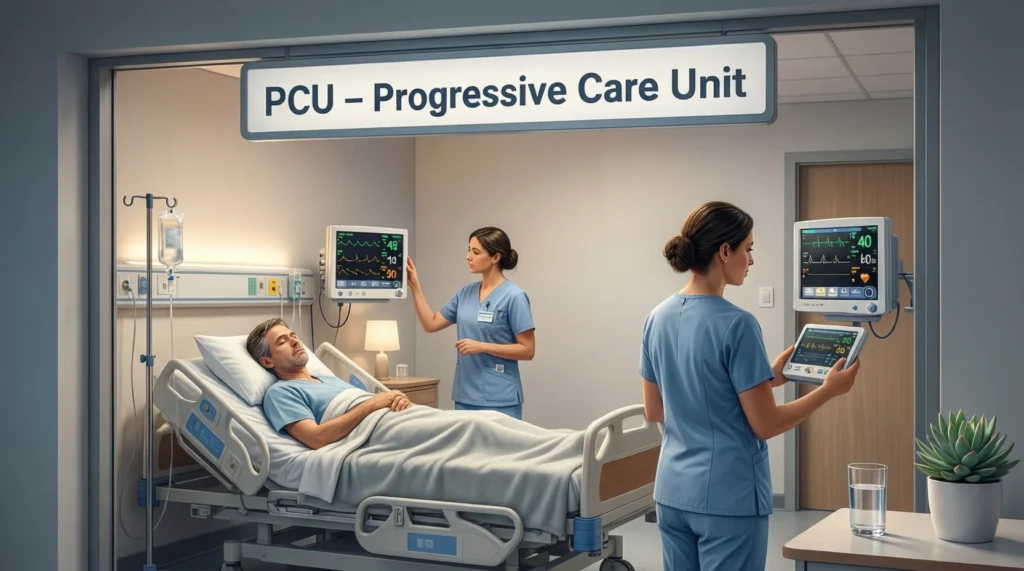
PCU in a hospital setting stands for Progressive Care Unit. It is a specialized hospital unit for patients who require more monitoring than a general medical-surgical floor but less intensive care than an Intensive Care Unit (ICU).
PCUs bridge the gap between critical care and standard hospital care, providing focused attention and advanced monitoring.
Hospitals can be confusing places, especially when you hear abbreviations like PCU and wonder what they mean. If you’ve ever been told a loved one is in the PCU, or if you’re a new patient navigating hospital care, understanding this term is essential.
PCU, or Progressive Care Unit, is a specialized hospital area that provides focused monitoring and support for patients who need more attention than a regular ward but less than an ICU.
It’s designed to ensure patients receive the right level of care as they recover from surgery, illness, or other medical conditions.
Understanding what a PCU is, who it serves, and how it operates is crucial for patients, families, and healthcare professionals navigating hospital care.
Origin of the PCU
The concept of a Progressive Care Unit emerged as hospitals recognized a need for intermediate patient care:
- Not every patient requires the full resources of an ICU.
- Some patients need closer monitoring than a general ward but are stable enough to avoid ICU admission.
PCUs evolved in the late 20th century to optimize hospital resources, improve patient safety, and reduce ICU congestion.
Key Idea:
A PCU provides specialized, high-quality care without the full intensity and cost of an ICU.
Purpose and Real-World Usage
Hospitals use PCUs for patients in transition:
- From ICU to regular ward: Patients recovering from major surgeries or serious illnesses may move to PCU as their condition stabilizes.
- High-risk patients: Those with heart problems, respiratory issues, or post-surgery complications may stay in a PCU for closer observation.
- Short-term monitoring: Some patients are admitted for frequent vital checks, IV medications, or cardiac monitoring.
Example Situations:
- A patient recovering from a heart attack may move from ICU to PCU before going home.
- A patient with severe pneumonia requiring oxygen support but not ICU-level intervention may be admitted to PCU.
What Makes a PCU Different from Other Units?
| Unit Type | Level of Care | Typical Patients | Key Features |
|---|---|---|---|
| ICU (Intensive Care Unit) | Highest | Critically ill | 24/7 monitoring, ventilators, complex interventions |
| PCU (Progressive Care Unit) | Intermediate | Patients needing closer monitoring | Frequent vitals, telemetry, specialized nursing |
| Medical-Surgical Floor | Standard | Stable patients | Routine care, less frequent monitoring |
Key Difference:
A PCU provides more attention than a standard ward but less than an ICU, offering flexibility for patients who are stable but still need observation.
Examples of PCU in Action
Scenario Table
| Patient Situation | Unit Assignment | Reason |
|---|---|---|
| Post-heart surgery, recovering but stable | PCU | Needs cardiac monitoring and IV medications |
| Severe pneumonia on oxygen therapy | PCU | Requires frequent vitals and respiratory support |
| Stroke recovery, stable vitals | PCU | Needs neurological checks and rehabilitation monitoring |
| Mild post-operative recovery | Medical-Surgical Floor | Stable, routine post-op care only |
Common Abbreviations Related to PCU
| Abbreviation | Meaning | Comparison to PCU |
|---|---|---|
| ICU | Intensive Care Unit | Higher intensity, more critical patients |
| CCU | Coronary Care Unit | Heart-focused ICU, similar to PCU for cardiac patients |
| Step-down Unit | Another term for PCU | Often used interchangeably |
| Telemetry Unit | Monitors heart activity | Similar to PCU but may be specialized |
Quick Tip:
Different hospitals may use slightly different names for PCU, but the core concept is always intermediate, closely monitored care.
Alternate Meanings of PCU in Hospitals
While Progressive Care Unit is the most common, PCU can also refer to:
- Pediatric Care Unit – specialized for children
- Postoperative Care Unit – immediate recovery after surgery
Always check hospital-specific documentation, as abbreviations may vary.
Polite and Professional Ways to Explain PCU
When talking to patients or families, clarity matters:
- “PCU is a step-down unit from the ICU, where patients get closer monitoring than a regular floor.”
- “This unit provides progressive care and frequent checks to ensure safe recovery.”
- “Patients in the PCU are stable but need more observation than in standard hospital rooms.”
These explanations reassure families and maintain a professional tone.
FAQs
- What does PCU stand for in a hospital?
Progressive Care Unit – an intermediate level of patient care. - How is PCU different from ICU?
PCU patients are stable but need monitoring, while ICU patients are critically ill. - Who gets admitted to a PCU?
Patients recovering from surgery, high-risk conditions, or needing frequent monitoring. - Is PCU the same as a step-down unit?
Yes, step-down units are another term for PCU in many hospitals. - Do PCU nurses require special training?
Yes, they are trained in advanced monitoring, telemetry, and post-surgical care. - How long do patients stay in PCU?
Typically until stable enough for discharge or transfer to a regular ward. - Can a patient go directly to PCU from the ER?
Yes, if they need monitoring beyond a standard ward but don’t require ICU care. - Is PCU covered by health insurance?
Yes, most insurance plans cover PCU stays as part of inpatient care.
Practical Tips for Patients and Families
- Ask about monitoring: Understand what vitals or tests will be done.
- Clarify visitation rules: PCUs often allow limited visitors compared to ICU.
- Know the level of care: PCU is intermediate care – patients are stable but still need attention.
- Coordinate with staff: Nurses and doctors in PCU can answer questions about recovery and next steps.
Conclusion
The Progressive Care Unit (PCU) is a vital part of modern hospitals, providing bridge care between ICU and general wards. It ensures patients receive the attention they need without the intensity of critical care.
Understanding PCU helps families navigate the hospital, understand recovery processes, and communicate effectively with healthcare professionals.
Discover More Related Articles:
- Biblical Meaning of Defiled: What It Really Means According to Scripture (2026)
- Perseverance Mean in the Bible: Lessons from Paul, Job, and Jesus for 2026

Ryan Thompson is an experienced content writer specializing in slang terms, texting abbreviations, and word meanings. He writes for meanvoro.com, where he creates accurate and easy-to-understand language content for readers.