
Grande in Spanish means big, large, or great. It is an adjective used to describe size, importance, intensity, or admiration, and its meaning changes depending on placement, context, and tone.
The Spanish word “grande meaning” is a common and versatile adjective used in everyday conversations. It generally means “big” or “large,” but its meaning can change depending on the context in which it is used. From describing physical size to expressing importance or greatness, “grande” plays an important role in Spanish vocabulary and communication.
If you have heard grande in a song lyric, a Spanish conversation, or while ordering coffee, you are not alone. It is one of the most common and versatile Spanish words, and it carries more nuance than a simple “big.” This guide explains everything clearly with real-world examples you can actually use.
Origin of the Word Grande

The Spanish word grande comes from the Latin word grandis, which meant large, grown, powerful, or important.
As Latin evolved into Spanish, grandis became grande while keeping both literal physical meanings and figurative meanings related to importance or greatness.
This dual meaning is why grande works naturally for objects, people, ideas, emotions, and social status.
Core Meanings of Grande in Spanish
Big or Large Physical Size
This is the most direct grande meaning.
Examples
Una casa grande means a big house
Un perro grande means a large dog
Un problema grande means a big problem
In these cases, grande describes physical or measurable size.
Great or Important Figurative Meaning
Grande is often used to describe importance, quality, or emotional value rather than size.
Examples
Un gran líder means a great leader
Una gran oportunidad means a great opportunity
Un gran momento means a great moment
Important grammar note
When grande comes before a noun, it changes to gran and usually means great rather than big.
Influential, Respected, or Powerful
In cultural or historical contexts, grande can imply prestige or influence.
Examples
Un gran artista means a great or famous artist
Una gran figura histórica means a major historical figure
This meaning focuses on impact, not physical size.
Grammar Rule That Changes the Meaning
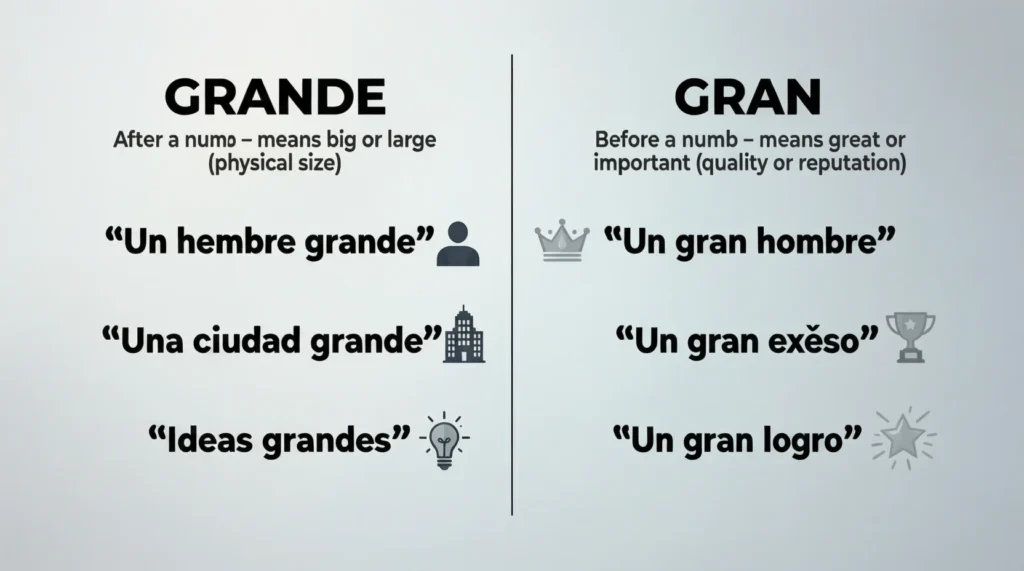
Grande vs Gran
Form and meaning comparison
Grande after a noun means big or large
Gran before a noun means great or important
Examples
Un hombre grande means a physically big man
Un gran hombre means a great man in character or reputation
Same word, different placement, different meaning.
Gender and Number Agreement
Grande does not change for masculine or feminine nouns.
It only changes in plural form.
Singular: grande
Plural: grandes
Examples
Una ciudad grande
Ciudades grandes
Ideas grandes
Tone and Emotional Nuance of Grande
The word grande itself is neutral, but context changes the tone.
Positive or admiring tone
Tienes un gran corazón means you have a big or kind heart
Neutral descriptive tone
Es una empresa grande means it is a large company
Negative or dramatic tone
Ese fue un gran error means that was a big mistake
Tone always comes from context, not the word alone.
Real World Usage of Grande
Daily Conversation
Grande is extremely common in everyday Spanish.
Common expressions
A lo grande means in a big way
Pensar en grande means think big
Grande como la vida means larger than life
Popular Culture
Grande appears frequently in music, movies, sports, and motivational language.
Example
Sueña en grande means dream big
Coffee and Size Usage
Outside Spanish-speaking countries, grande is often used as a drink size due to global coffee culture.
Important clarification
In real Spanish-speaking countries, drink sizes are usually described as mediano for medium and grande for large, without special branding meanings.
Comparison With Similar Spanish Words
Grande vs Grandeza
Grande means big or great
Grandeza means greatness or nobility
Grandeza is more formal and abstract and is often used in literature or speeches.
Grande vs Enorme
Grande means big or great and is neutral
Enorme means huge or enormous and sounds stronger or more dramatic
Example
Un problema grande is a big problem
Un problema enorme is a huge problem
Grande vs Amplio
Grande focuses on overall size or importance
Amplio focuses on width, space, or openness
Alternate Meanings of Grande
Depending on context, grande can also imply:
Maturity
Ya está grande means he or she is grown up
Intensity
Un gran dolor means great pain
Generosity
Un gesto grande means a grand or generous gesture
Polite and Professional Alternatives to Grande
In formal writing, Spanish speakers may use more precise words.
Instead of grande, you may see:
Importante
Significativo
Destacado
Considerable
These sound more refined in academic or business settings.
Example Usage Table
Sentence, meaning, and tone
Es una ciudad grande
It is a big city
Neutral
Es un gran logro
It is a great achievement
Positive
Cometí un gran error
I made a big mistake
Negative
Tiene un corazón grande
He or she has a big heart
Warm
Pensamos en grande
We think big
Motivational
Common Mistakes Learners Make
Using grande before a noun when referring to physical size
Forgetting that gran is the shortened form
Translating grande literally without checking context
Correct approach
Always ask whether you are talking about size or importance.
FAQs
- What does grande literally mean in Spanish
It literally means big or large, but it often means great or important depending on context. - Is grande masculine or feminine
It works for both and does not change by gender. - What is the difference between gran and grande
Gran comes before a noun and means great. Grande comes after and means big. - Can grande describe people
Yes, it can describe physical size, character, or importance. - Is grande formal or informal
It works naturally in both casual and professional Spanish. - Can grande mean famous
Yes, indirectly, when referring to someone influential or respected. - Is grande used in all Spanish-speaking countries
Yes, it is universal across Spain and Latin America. - Can grande have a negative meaning
Yes, especially when used with mistakes, problems, or errors.
Conclusion
In conclusion, the Spanish word “grande” is a versatile adjective that primarily means “big” or “large,” but it can also convey ideas like “great,” “important,” or “impressive” depending on the context. Its meaning often goes beyond physical size, reflecting emotional or qualitative significance as well, which makes it a commonly used and expressive word in everyday Spanish.
Discover More Related Articles:
- JOI Mean in Porn | Understanding the Adult Content Slang Term In 2026
- The Root Tele Mean in Television | Understanding the Word’s Origin In 2026
- Closed Circle Mean in Math |The Symbol Most Students Misunderstand In 2026

Madison Taylor is an experienced content writer who focuses on researching and explaining word meanings, slang, and texting terms. She writes for meanvoro.com, creating clear and accurate to help readers understand language easily.