Definition
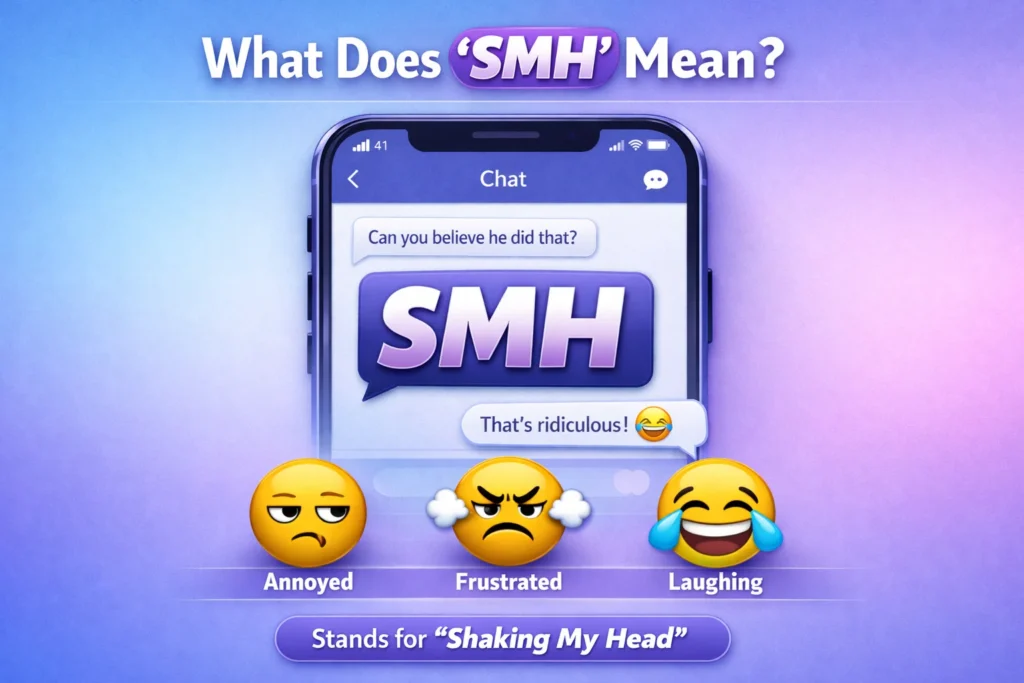
SMH stands for “shaking my head.” It is commonly used in text messages, social media, and online chats to express disappointment, disbelief, frustration, or mild disapproval toward a situation or someone’s behavior.
If you’ve spent even a few minutes scrolling through social media, you’ve probably come across “SMH” more times than you can count. It pops up in tweets, comments, captions, and messages often without much explanation.
But what exactly does it mean? Is it rude? Funny? Serious?
Understanding slang like “SMH” isn’t just about keeping up with trends it helps you communicate clearly and interpret tone correctly in digital conversations. In this guide, you’ll learn everything you need to know about “SMH,” from its meaning and origin to real-life usage, tone variations, and alternatives.
What Does SMH Mean in Text?
At its core, SMH = “shaking my head.”
It’s a reaction phrase used when someone feels:
- Disappointed 😞
- Annoyed 😒
- Shocked 😳
- Embarrassed for someone 😬
- Frustrated 😤
Think of it as the digital version of physically shaking your head when something doesn’t make sense or feels disappointing.
Origin of SMH
The abbreviation “SMH” originated in early internet culture, especially in:
- Chatrooms
- Forums
- SMS texting
As texting became more common, people started shortening phrases to save time. Just like “LOL” (laugh out loud) and “BRB” (be right back), “SMH” became a quick way to express emotion without typing a full sentence.
Its popularity exploded with:
- Twitter (short-form messaging)
- Facebook comments
- Instagram captions
- TikTok reactions
Today, it’s a universal slang term understood across different age groups and cultures.
How SMH Is Used in Real Conversations
“SMH” is usually used as a reaction rather than a full statement. It often appears at the beginning or end of a sentence.
Common Usage Styles:
- Standalone:
“SMH.” - At the beginning:
“SMH, I can’t believe this happened.” - At the end:
“You forgot again, SMH.”
Tone and Meaning of SMH
The meaning of “SMH” can shift depending on tone and context.
1. Mild Disappointment (Friendly Tone)
Used casually with friends.
Example:
“SMH, you still haven’t watched that movie 😂”
👉 Tone: Playful, teasing
2. Frustration or Annoyance (Neutral Tone)
Used when something is irritating.
Example:
“SMH, the internet is down again.”
👉 Tone: Slightly annoyed
3. Disapproval or Judgment (Negative Tone)
Used when someone strongly disagrees.
Example:
“SMH, why would you do that?”
👉 Tone: Critical or disapproving
4. Disbelief or Shock
Used when something seems unbelievable.
Example:
“SMH, people actually believe this?”
👉 Tone: Surprised + disappointed
Examples of SMH in Text Conversations
Example Table: Real-Life Usage of SMH
| Situation | Message Example | Tone |
|---|---|---|
| Friend forgot plans | “You forgot again? SMH 😅” | Playful |
| Bad decision | “SMH, that was not a good idea.” | Critical |
| Tech issue | “SMH, my phone just died.” | Frustrated |
| Social media post | “SMH at these comments.” | Disapproving |
| Funny mistake | “SMH 😂 you’re so clumsy” | Lighthearted |
When to Use SMH (and When Not To)
Use SMH When:
- You want to react quickly
- You’re chatting casually
- You’re expressing mild frustration or disbelief
- You’re joking with friends
Avoid SMH When:
- Writing formal emails
- Communicating professionally
- Talking to someone who may misunderstand slang
- Discussing sensitive topics
Is SMH Rude?
Not always but it can be.
When It’s Not Rude:
- Used jokingly with friends
- Paired with emojis 😂
- Used in a light tone
When It Can Be Rude:
- Used in arguments
- Directed at someone personally
- Used without context
Example:
“SMH at you.” → Sounds more offensive
Comparison With Similar Slang Terms
Understanding “SMH” is easier when compared with similar abbreviations.
SMH vs Other Common Text Slang
| Term | Meaning | Tone | When to Use |
|---|---|---|---|
| SMH | Shaking my head | Disapproval / frustration | When something is disappointing |
| LOL | Laugh out loud | Positive | When something is funny |
| OMG | Oh my God | Surprise | For shock or excitement |
| IDC | I don’t care | Neutral/negative | When uninterested |
| TSK | Expression of disapproval | Mild negative | Softer version of SMH |
👉 Key difference:
- SMH = disappointment or disbelief
- LOL = amusement
Alternate Meanings of SMH
While “shaking my head” is the most common meaning, SMH can occasionally stand for other things depending on context:
- So Much Hate
- Scratch My Head
However, these meanings are rare and usually clear from context.
Polite or Professional Alternatives to SMH
If you’re in a formal or professional setting, it’s better to avoid slang like “SMH.” Instead, use:
Polite Alternatives:
- “That’s unfortunate.”
- “I find that surprising.”
- “That’s disappointing.”
- “I don’t agree with that.”
- “That could have been handled better.”
Example Conversion:
- Casual: “SMH, this is wrong.”
- Professional: “This doesn’t seem accurate.”
SMH in Social Media Culture
“SMH” is extremely popular on platforms like:
- Twitter/X
- TikTok
It’s often used in:
- Reaction posts
- Memes
- Comment sections
Example:
“SMH at how expensive everything is now 😭”
👉 This shows shared frustration and relatability.
Tips for Using SMH Correctly
- ✔ Use it in casual conversations
- ✔ Pair it with emojis for tone clarity
- ✔ Avoid using it in serious discussions
- ✔ Be mindful of how it may sound to others
- ✔ Don’t overuse it keep it natural
FAQs
1. What does SMH mean in texting?
SMH means “shaking my head,” and it is used to express disappointment, frustration, or disbelief in a situation.
2. Is SMH a negative term?
Not always. It can be used in a light, playful way or in a more serious tone depending on the context.
3. Can SMH be used in a funny way?
Yes, it is often used humorously, especially when combined with emojis like 😂 or 😅 to show playful teasing.
4. Is SMH rude in conversations?
It can be considered rude if it is directed at someone in a harsh or critical way, but in casual use it is usually harmless.
5. What is the difference between SMH and OMG?
SMH shows disappointment or disapproval, while OMG expresses surprise, shock, or excitement.
6. Should I use SMH in professional messages?
No, it is better to avoid slang like SMH in professional communication and use more formal expressions instead.
7. What does “SMH at you” mean?
It means the speaker is expressing disappointment or disapproval toward someone’s actions or behavior.
8. Is SMH still popular in 2026?
Yes, SMH is still widely used in texting, social media posts, and online conversations in 2026.
Conclusion:
“SMH” is a simple yet powerful expression that captures a wide range of emotions from mild frustration to strong disapproval.
Here’s what to remember:
- It means “shaking my head”
- It’s best used in casual conversations
- Tone depends heavily on context and emojis
- It can be playful or critical
- Avoid it in formal communication
Used correctly, “SMH” can add personality and emotion to your messages without needing long explanations.
Discover More Related Articles:
- Yellow Card Mean in Volleyball: Causes and Consequences (2026)
- RD Mean in a Text: On Snapchat, WhatsApp & Instagram in 2026

Madison Taylor is an experienced content writer who focuses on researching and explaining word meanings, slang, and texting terms. She writes for meanvoro.com, creating clear and accurate to help readers understand language easily.