

Definition
CI in police terms stands for “Confidential Informant.”
A Confidential Informant (CI) is an individual who provides law enforcement agencies with sensitive or insider information about criminal activities while their identity is kept secret to ensure their safety and the integrity of ongoing investigations.
Ever watched a crime drama or read a news report and noticed the abbreviation “CI” being used during an investigation or courtroom scene? At first, it may seem like just another technical term, but in reality, it holds important meaning within law enforcement.
In police terminology, “CI” is commonly used in serious investigative contexts, often referring to individuals or roles that play a key part in gathering information and supporting criminal cases. Because of its importance, the term frequently appears in discussions about ongoing investigations, undercover operations, and legal proceedings.
Understanding what “CI” means in police work can give you a clearer picture of how investigations actually function behind the scenes and how crucial information is collected to solve cases.
Understanding the Meaning of CI in Law Enforcement

In the world of policing, intelligence is often the key to solving crimes. A Confidential Informant plays a crucial role by supplying information that may not be accessible through traditional investigative methods. These individuals can be involved in or closely connected to criminal networks, enabling them to provide firsthand insights.
Key Characteristics of a CI
- Anonymity: Their identity is protected to prevent retaliation.
- Insider Access: They often have direct knowledge of criminal activities.
- Voluntary or Incentivized: Some provide information willingly, while others may receive compensation or legal consideration.
- Ongoing Relationship: Law enforcement may maintain long-term collaboration with reliable informants.
- Documented Status: Agencies typically assign a control number and maintain records of interactions.
Origin of the Term “Confidential Informant”

The use of informants dates back centuries, long before modern policing systems were established. Governments and law enforcement agencies have historically relied on insiders to gather intelligence about criminal or political activities.
Historical Evolution
| Era | Development |
|---|---|
| 18th–19th Century | Early police forces in Europe and North America used informants to monitor criminal gangs. |
| Early 20th Century | Organized crime investigations increased reliance on informants. |
| Modern Era | Formalized procedures and legal protections were introduced, especially within agencies like the FBI and Scotland Yard. |
Today, the term Confidential Informant (CI) is standardized across many law enforcement agencies worldwide, including police departments, federal agencies, and narcotics units.
Why Confidential Informants Are Important
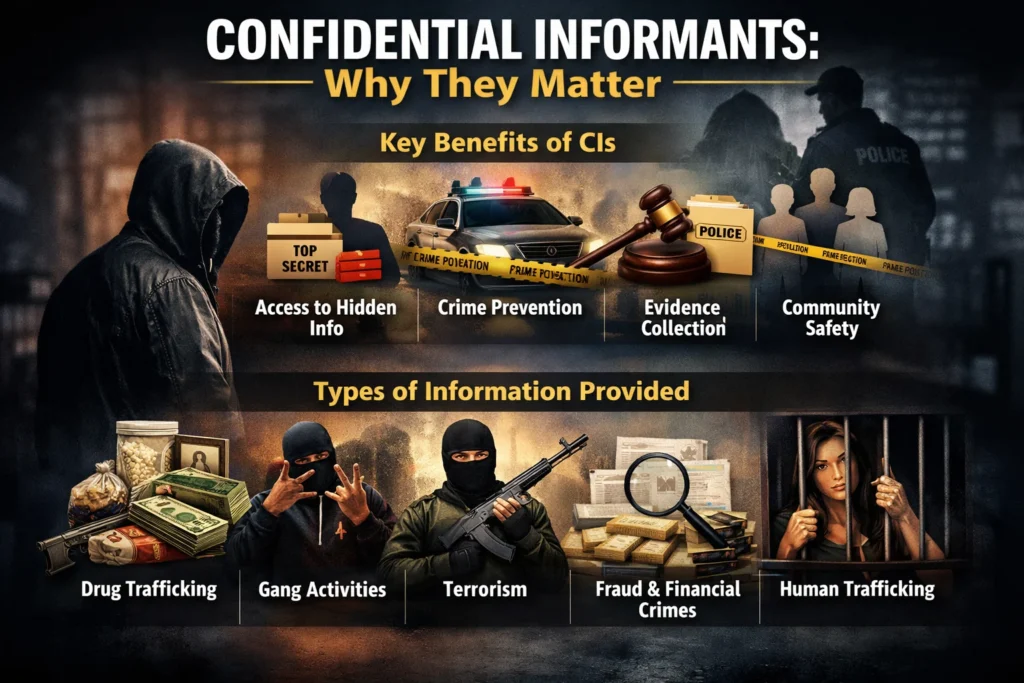
Confidential informants are indispensable to effective policing. They help authorities prevent crimes, dismantle criminal organizations, and gather evidence for prosecution.
Major Benefits of Using CIs
- Access to Hidden Information: Provide insights into secretive criminal operations.
- Crime Prevention: Enable law enforcement to intervene before crimes occur.
- Evidence Collection: Assist in building strong legal cases.
- Cost-Effective Intelligence: Often less expensive than extensive surveillance operations.
- Community Safety: Help remove dangerous individuals from society.
Types of Information Provided
- Drug trafficking operations
- Gang activities
- Terrorism-related intelligence
- Fraud and financial crimes
- Human trafficking networks
How Confidential Informants Are Used in Investigations
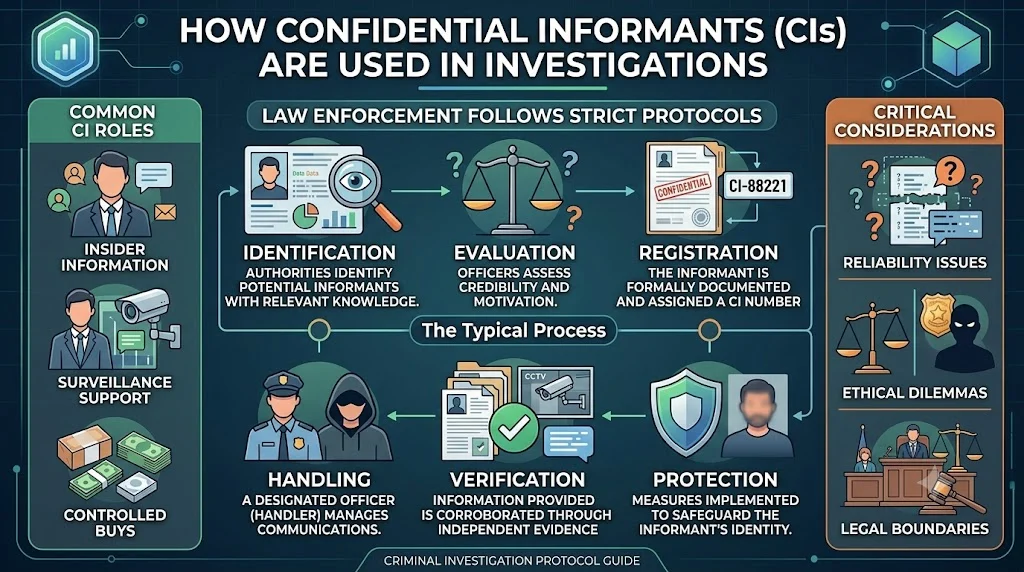
Law enforcement agencies follow strict protocols when working with confidential informants to ensure legality and reliability.
The Typical Process
- Identification: Authorities identify potential informants with relevant knowledge.
- Evaluation: Officers assess credibility and motivation.
- Registration: The informant is formally documented and assigned a CI number.
- Handling: A designated officer (often called a handler) manages communications.
- Verification: Information provided is corroborated through independent evidence.
- Protection: Measures are implemented to safeguard the informant’s identity.
Real-World Usage of “CI” in Police Communication
The abbreviation CI is commonly used in police reports, court documents, and media coverage.
Example Sentences with Context
| Example Sentence | Context | Tone |
|---|---|---|
| “According to a CI, the suspect planned the robbery for Friday night.” | Police report | Neutral |
| “The arrest was made after a CI provided crucial information.” | News article | Neutral |
| “Defense attorneys questioned the credibility of the CI.” | Courtroom setting | Neutral/Skeptical |
| “Our CI tipped us off just in time! 🚔” | Informal conversation | Friendly |
Tone Explanations
- Friendly: Used in casual or conversational contexts.
- Neutral: Standard tone in official reports and media.
- Skeptical/Negative: Appears when the reliability or motives of a CI are questioned.
Legal and Ethical Considerations
While confidential informants are valuable, their use also raises legal and ethical concerns.
Key Considerations
- Credibility: Informants may provide false information to gain benefits.
- Entrapment Risks: Law enforcement must avoid inducing crimes.
- Safety: Protecting the informant’s identity is essential.
- Documentation: Proper records ensure accountability.
- Judicial Scrutiny: Courts often examine the reliability of CI testimony.
Legal Safeguards
- Corroboration of information before action.
- Judicial oversight in warrant applications.
- Disclosure requirements under certain legal standards (e.g., Brady obligations in the United States).
Comparison with Related Police Terms
Understanding CI becomes easier when compared with similar law enforcement abbreviations.
Comparison Table
| Term | Full Form | Meaning | Key Difference |
|---|---|---|---|
| CI | Confidential Informant | Provides secret information while remaining anonymous. | Identity protected; may be involved in criminal circles. |
| UC | Undercover Officer | A law enforcement officer operating covertly. | Is a trained officer, not a civilian. |
| CHS | Confidential Human Source | Intelligence community term similar to CI. | Often used by federal agencies. |
| Witness | — | Provides testimony about events they observed. | Identity usually known and not confidential. |
| Source | — | General term for any information provider. | Broader and less specific than CI. |
CI vs. Undercover Officer: Key Differences
| Feature | Confidential Informant (CI) | Undercover Officer (UC) |
|---|---|---|
| Employment | Civilian | Law enforcement officer |
| Identity | Protected | May be concealed during operations |
| Motivation | Payment, leniency, or civic duty | Professional responsibility |
| Training | Typically none | Specialized law enforcement training |
| Legal Authority | Limited | Full police authority |
Alternate Meanings of “CI”
Although CI most commonly refers to a Confidential Informant in policing, it can have other meanings depending on the context.
| Field | Meaning |
|---|---|
| Military | Counterintelligence |
| Business | Corporate Identity |
| Technology | Continuous Integration |
| Medical | Cardiac Index or Confidence Interval |
| Education | Continuous Improvement |
Understanding the surrounding context is essential to determine the correct interpretation.
Professional and Polite Alternatives
In formal or public communication, law enforcement agencies may use alternative terms to maintain clarity and professionalism.
Common Alternatives
- Confidential Source
- Reliable Informant
- Human Source
- Anonymous Tipster (less formal)
- Cooperating Witness (when the individual testifies in court)
When to Use Each
| Term | Best Used In |
|---|---|
| Confidential Source | Intelligence or federal contexts |
| Reliable Informant | Emphasizing credibility |
| Cooperating Witness | Legal proceedings |
| Anonymous Tipster | Media or public communication |
Popularity of the Term in Media and Pop Culture
Crime dramas and news reporting have popularized the abbreviation CI, making it widely recognized by the public. Television shows, documentaries, and podcasts often portray informants as pivotal figures in solving complex cases. However, these portrayals sometimes dramatize their roles, overlooking the strict legal and procedural frameworks governing their use.
Advantages and Disadvantages of Using Confidential Informants
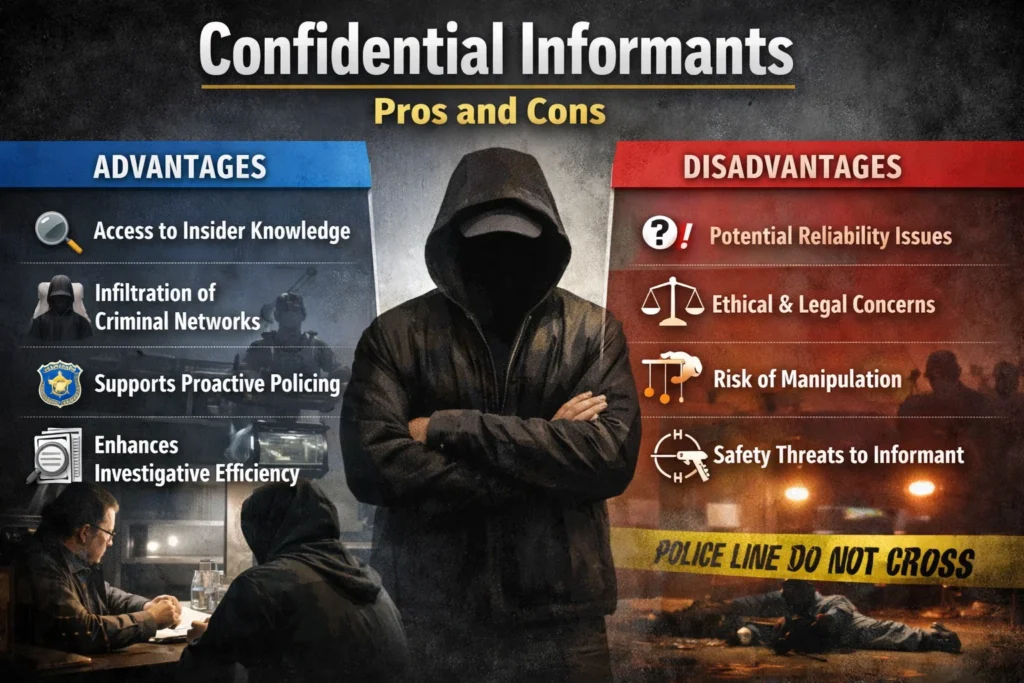
Advantages
- Access to insider knowledge.
- Ability to infiltrate criminal networks.
- Supports proactive policing.
- Enhances investigative efficiency.
Disadvantages
- Potential reliability issues.
- Ethical and legal concerns.
- Risk of manipulation.
- Safety threats to the informant.
Practical Usage Tips
If you encounter the term CI in professional or academic writing, consider the following tips:
- Clarify on First Use: Spell out “Confidential Informant” before using the abbreviation.
- Provide Context: Ensure readers understand the role of the CI in the investigation.
- Avoid Assumptions: Recognize that motivations and reliability can vary.
- Use Neutral Language: Maintain objectivity when discussing informants.
FAQs
1. What does CI stand for in police terms?
CI stands for “Confidential Informant,” a person who secretly provides information to law enforcement about criminal activities.
2. Is a CI the same as an undercover officer?
No. A CI is typically a civilian providing information, while an undercover officer is a trained law enforcement professional operating covertly.
3. Are confidential informants paid?
Yes, some CIs receive financial compensation, reduced sentences, or other incentives, though some cooperate voluntarily.
4. Is the identity of a CI always protected?
Generally, yes. However, in certain legal situations, courts may require disclosure if it is essential for a fair trial.
5. Can a criminal become a confidential informant?
Yes. Individuals involved in criminal activities often become CIs in exchange for leniency or other benefits.
6. How reliable are confidential informants?
Reliability varies. Law enforcement agencies typically corroborate information before taking action.
7. What is the difference between a CI and a cooperating witness?
A CI provides information confidentially, while a cooperating witness may testify openly in court.
8. Is the term CI used internationally?
Yes, although terminology may vary. Many countries use similar concepts such as “informant” or “human source.”
Conclusion
Understanding what CI means in police terms offers valuable insight into the inner workings of criminal investigations. A Confidential Informant is a vital asset for law enforcement, providing insider information that helps prevent crime, dismantle criminal organizations, and support successful prosecutions.
By recognizing the significance and nuances of this term, readers can better interpret police reports, news articles, and crime-related media.
Discover More Related Articles:

Ryan Thompson is an experienced content writer specializing in slang terms, texting abbreviations, and word meanings. He writes for meanvoro.com, where he creates accurate and easy-to-understand language content for readers.