
Definition:
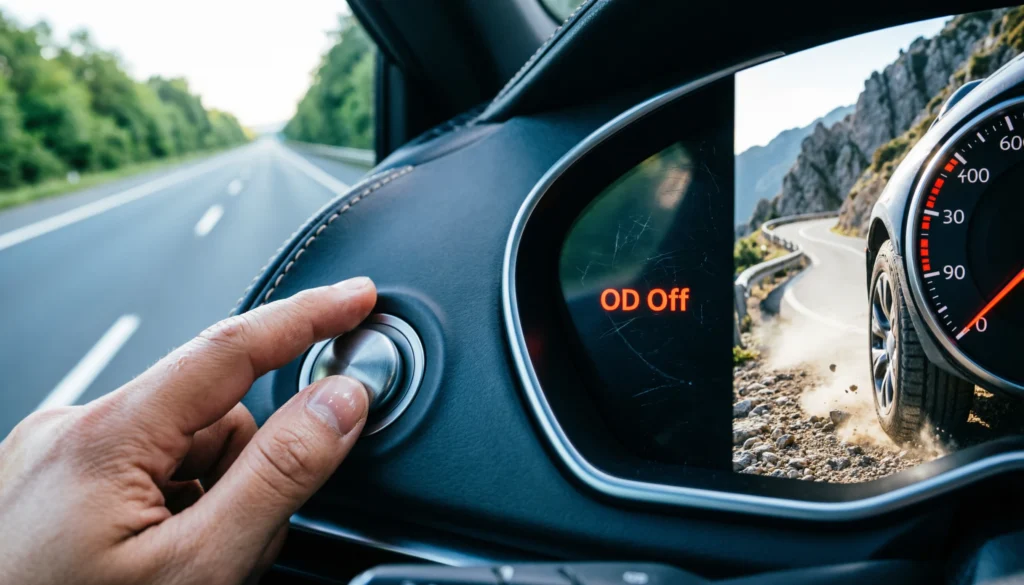
“OD Off” (Overdrive Off) in a car means the transmission’s overdrive gear is disabled, preventing the vehicle from shifting into its highest gear.
This results in higher engine RPMs, more power at lower speeds, and better control especially useful for towing, climbing hills, or driving in stop-and-go traffic.
You’re cruising along, everything seems fine and suddenly you notice a small “OD Off” light on your dashboard. 🤔 Should you worry? Is something wrong with your car?
Good news: it’s usually not a problem at all.
In fact, “OD Off” is a feature, not a fault. But understanding when to use it and when to turn it off can make a big difference in your driving experience, fuel efficiency, and even your car’s long-term health.
Let’s break it down in a simple, clear, and practical way.
What Is Overdrive (OD) in a Car?
Before understanding “OD Off,” you need to know what overdrive (OD) actually is.
Simple Explanation:
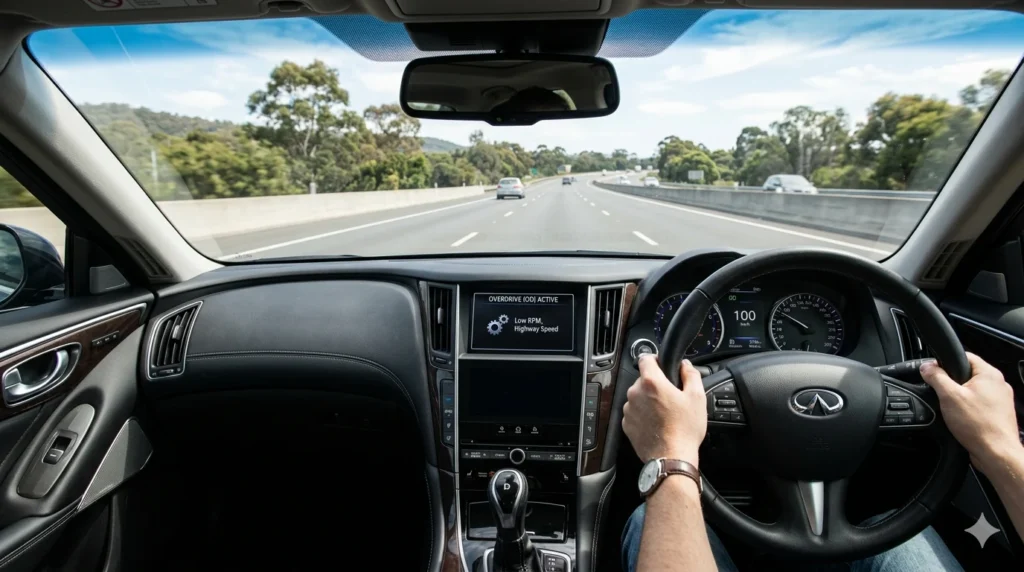
Overdrive is the highest gear in an automatic transmission that allows your engine to run at lower RPMs while maintaining speed.
Why Overdrive Exists:
- Improves fuel efficiency 🚗💨
- Reduces engine wear
- Makes highway driving smoother and quieter
Example:
When you’re driving at 80–100 km/h on a highway, your car shifts into overdrive to save fuel and reduce engine strain.
What Happens When You Turn “OD Off”?
When you press the OD button (usually on the gear lever), you disable overdrive.
Here’s What Changes:
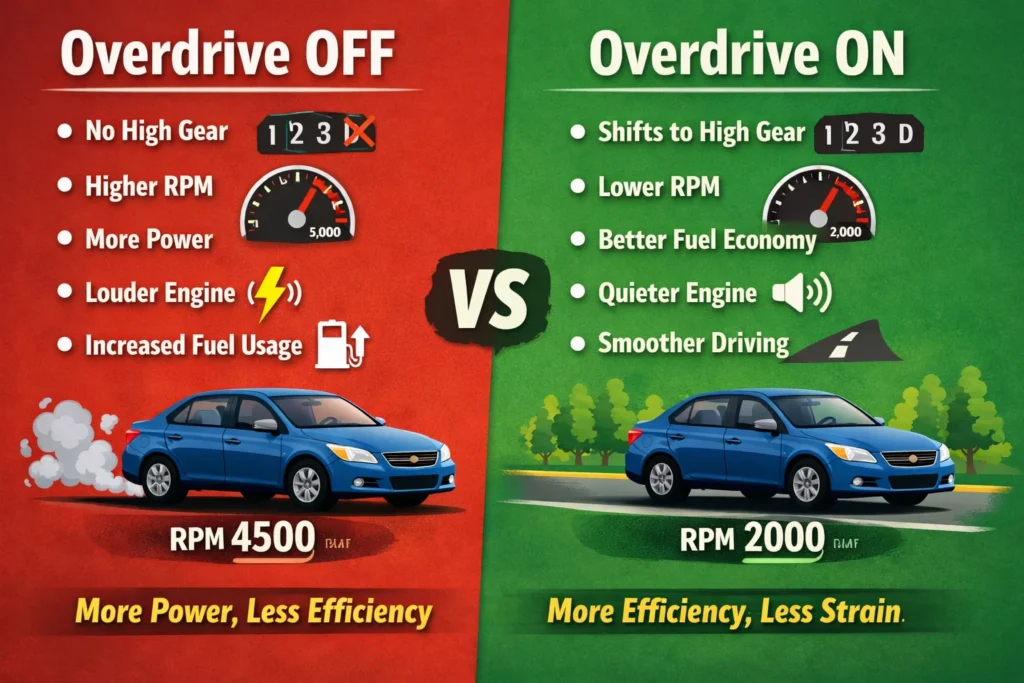
- ❌ Car won’t shift into highest gear
- 🔼 Engine RPM increases
- ⚡ More power at lower speeds
- 🔊 Engine may sound louder
- ⛽ Fuel consumption increases
In Simple Terms:
OD Off = More power, less efficiency
OD On = More efficiency, less strain
When Should You Use “OD Off”?
Using “OD Off” correctly can actually improve your driving experience.
Best Situations to Use OD Off:
1. Driving Uphill ⛰️
- Prevents constant gear shifting
- Gives more torque and power
2. Towing Heavy Loads 🚚
- Keeps engine in a stronger power range
- Protects transmission
3. Stop-and-Go Traffic 🚦
- Avoids unnecessary shifting
- Makes driving smoother
4. Driving on Slippery Roads 🌧️
- Provides better control at lower gears
5. Going Downhill (Engine Braking) ⬇️
- Helps control speed without overusing brakes
When Should You NOT Use “OD Off”?
Keeping OD off unnecessarily can hurt fuel economy.
Avoid Using OD Off When:
- 🚗 Driving at constant high speed on highways
- 🛣️ Long-distance cruising
- ⛽ Trying to save fuel
Rule of Thumb:
👉 Highway = OD On
👉 Heavy load or rough driving = OD Off
Where Is the OD Button Located?
The OD button is usually:
- On the gear shift lever
- Sometimes labeled as “O/D” or “OD Off”
- In modern cars, it may be integrated into drive modes
When you press it:
- The “OD Off” light appears on your dashboard
Real-World Usage Examples
Here’s how “OD Off” works in everyday driving situations:
Friendly Scenario 😊
“I turned OD off while driving up the hill my car felt way more powerful!”
Neutral Scenario 😐
“The OD Off light is on because I’m towing a trailer.”
Slightly Negative/Dismissive Tone 😅
“Why is your OD off? No wonder your car is using so much fuel!”
OD Off vs Other Transmission Terms
Understanding related terms helps avoid confusion.
Comparison Table:
| Term | Meaning | When to Use |
|---|---|---|
| OD On | Overdrive enabled | Highway driving |
| OD Off | Overdrive disabled | Hills, towing, traffic |
| Drive (D) | Normal automatic driving mode | Everyday use |
| Low Gear (L) | Limits car to lower gears | Steep hills, heavy loads |
| Sport Mode | Higher RPM for performance | Fast driving, overtaking |
Is “OD Off” Bad for Your Car?
Short answer: No, but misuse can be inefficient.
Safe Use:
- Using OD off occasionally is perfectly fine
- Helps in specific driving conditions
Potential Downsides:
- Higher fuel consumption ⛽
- Increased engine noise 🔊
- More wear if used unnecessarily
Origin and Popularity of “OD Off”
Where Did It Come From?
The term “overdrive” dates back to older manual transmissions, where an extra gear allowed the driveshaft to spin faster than the engine.
With automatic cars, this feature became standard and the OD Off button gave drivers manual control.
Why It’s Popular Today:
- Found in most automatic vehicles
- Useful in diverse driving conditions
- Still relevant despite modern automatic systems
Even newer cars with advanced transmissions may automatically manage overdrive, but the concept remains the same.
Alternate Meanings of “OD”
While “OD” in cars means overdrive, it can mean other things in different contexts:
- OD (Overdose) – Medical term
- OD (On Demand) – Streaming/content platforms
- OD (Officer of the Day) – Military
👉 Always consider the context to avoid confusion.
Polite or Professional Alternatives
If you’re explaining “OD Off” to someone unfamiliar:
- “Overdrive is turned off.”
- “The car is not using its highest gear.”
- “It’s set for better power instead of fuel efficiency.”
These sound clearer and more professional.
Practical Tips for Drivers
Here are some smart tips to remember:
- ✔️ Use OD Off only when needed
- ✔️ Turn it back on for highways
- ✔️ Watch your RPM and fuel usage
- ✔️ Don’t panic if the light appears
FAQs:
1. What happens if I drive with OD off all the time?
Your car will use more fuel and run at higher RPMs, but it won’t immediately damage the engine.
2. Is it safe to turn OD off while driving?
Yes, it’s completely safe in most cars.
3. Does OD off make the car faster?
Not exactly faster, but it provides better acceleration and power.
4. Why does my OD Off light stay on?
You may have pressed the OD button. Press it again to turn it off.
5. Is OD off good for city driving?
Yes, especially in heavy traffic or stop-and-go conditions.
6. Should OD be on or off on highways?
Always on for better fuel efficiency.
7. Does OD off help in snow or rain?
Yes, it can improve control by keeping the car in lower gears.
8. Is OD off the same as sport mode?
No. Sport mode adjusts multiple settings, while OD off only disables the highest gear.
Conclusion:
“OD Off” is a simple but powerful feature that gives you more control over how your car performs in different driving situations. By disabling the overdrive gear, your vehicle stays in lower gears longer, providing better power and responsiveness when you need it most like during uphill drives, heavy traffic, or towing.
However, for everyday highway driving, keeping overdrive on is the smarter choice for fuel efficiency and a smoother ride. Understanding when to use “OD Off” helps you drive more confidently, protect your vehicle, and get the best balance between performance and efficiency.
Discover More Related Articles:
- “Sustain” Mean in a Court of Law: Sustain vs Overrule in 2026
- Rhythm Mean in Music: From Classical to Modern Songs in 2026

Ryan Thompson is an experienced content writer specializing in slang terms, texting abbreviations, and word meanings. He writes for meanvoro.com, where he creates accurate and easy-to-understand language content for readers.