Definition:
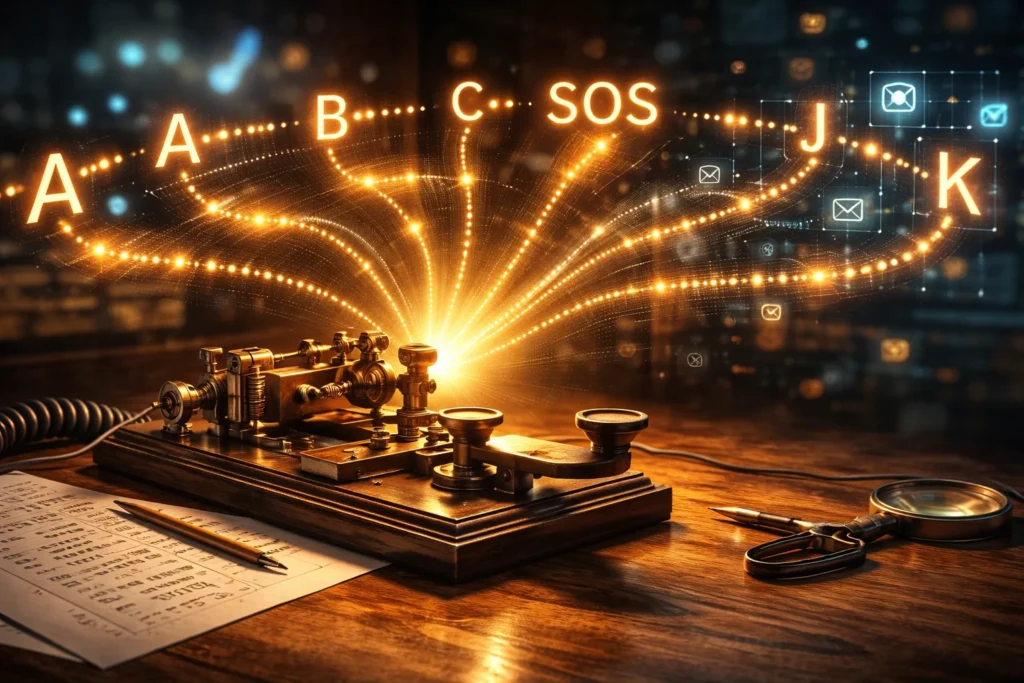
Morse code is a communication system that represents letters, numbers, and punctuation using sequences of dots (.) and dashes (-), used to transmit messages through sound, light, or signals.
In simple words:
👉 Morse code is a way of spelling messages using short and long signals instead of letters.
Morse code is one of the oldest and most fascinating communication systems in the world. Even in today’s digital age, it still appears in movies, emergency signals, aviation, amateur radio, and even internet culture. But many people often search the phrase “what does mean in Morse code” when trying to decode symbols like dots and dashes or understand how messages are formed.
If you’ve ever seen something like “… — …” and wondered what it means, you’re in the right place.
Morse code turns letters, numbers, and symbols into a simple system of dots (.) and dashes (-) allowing messages to be transmitted through sound, light, or signals.
What Is Morse Code?
Morse code is a method of encoding text characters into standardized sequences of dots (short signals) and dashes (long signals).
Each letter of the alphabet has its own unique pattern. For example:
- A = .-
- B = -…
- C = -.-.
- SOS = … — …
It was designed to make communication possible over long distances using telegraph systems, and it remains useful today in emergency communication and amateur radio.
Origin and History of Morse Code
Morse code was developed in the 1830s and 1840s by:
- Samuel Morse
- Alfred Vail
Why it was created:
Before phones and the internet, people needed a way to send messages quickly over long distances using electrical signals.
Key historical moments:
- First used in telegraph systems
- First official message: “What hath God wrought”
- Widely used in railways, military communication, and shipping
Even though modern communication replaced it, Morse code is still taught and used in specialized fields.
How Morse Code Works
Morse code uses two basic signals:
| Symbol | Meaning | Duration |
|---|---|---|
| . | Dot (short) | Quick tap |
| – | Dash (long) | Longer signal |
Basic Rules:
- A dot is short
- A dash is about 3 times longer than a dot
- Letters are separated by short pauses
- Words are separated by longer pauses
Common Morse Code Examples
Here are some real-world examples of Morse code translations:
Alphabet Examples
| Letter | Morse Code |
|---|---|
| A | .- |
| B | -… |
| C | -.-. |
| D | -.. |
| E | . |
| S | … |
| O | — |
Famous Word Example: SOS
SOS = … — …
This is the most recognized distress signal in the world.
Meaning:
- “Save Our Ship” (commonly interpreted)
- Emergency call for help
Example in a Sentence
Let’s say:
👉 HELLO in Morse code:
.... . .-.. .-.. ---
Why Morse Code Is Still Used Today
Even though it’s old technology, Morse code is still relevant.
Modern uses include:
- Emergency signaling (SOS flashes)
- Aviation and military communication
- Amateur radio operators (HAM radio)
- Education and historical studies
- Assistive communication for disabilities
Why it still matters:
- Works without internet or electricity
- Can be sent using light, sound, or touch
- Very reliable in emergencies
Tone and Meaning in Morse Code Communication
Unlike spoken language, Morse code doesn’t directly carry emotional tone but the way it is sent can express urgency or emotion.
Examples:
- Neutral:
.... . .-.. .-.. ---(HELLO) - Emergency (urgent tone):
... --- ... !!! - Slow, spaced signals = confusion or distress
- Fast repeated signals = urgency or excitement
So while Morse code itself is neutral, delivery matters a lot.
Comparison With Related Communication Systems
| System | Format | Speed | Usage Today |
|---|---|---|---|
| Morse code | Dots & dashes | Medium | Emergency, radio |
| Binary code | 0s and 1s | Fast | Computers |
| SMS language | Abbreviations/text | Very fast | Messaging |
| Braille | Raised dots | Medium | Visually impaired |
Key difference:
Morse code is sound/light-based, while modern systems are mostly digital or visual text-based.
Alternative Meanings of Morse Code
While Morse code itself has one primary meaning, the phrase can sometimes be confused with:
- “Hidden messages in dots and dashes”
- Secret codes in movies or games
- Decorative patterns in digital art
- Emergency signal interpretation (SOS)
But technically, it always refers to the same encoding system.
Polite or Professional Alternatives
If you’re explaining Morse code in writing or conversation, you can use:
- “Morse code system”
- “dot-and-dash communication”
- “telegraph encoding system”
- “signal-based alphabet system”
These sound more formal and professional.
Real-Life Uses of Morse Code
1. Emergency Situations
- SOS light signals
- Flashlight communication
2. Aviation & Marine
- Backup communication system
- Navigation signals
3. Amateur Radio
- HAM operators still use it worldwide
4. Education
- Teaching coding logic and history
Example Table – Morse Code in Action
| Message | Morse Code | Usage Context |
|---|---|---|
| SOS | … — … | Emergency distress |
| YES | -.– . … | Basic response |
| HELP | …. . .-.. .–. | Emergency request |
| HI | …. .. | Casual greeting |
FAQs
1. What does Morse code actually mean?
It is a system that represents letters and numbers using dots and dashes.
2. Who invented Morse code?
It was developed by Samuel Morse and Alfred Vail.
3. Is Morse code still used today?
Yes, mainly in emergency signals, aviation, and amateur radio.
4. What is SOS in Morse code?
SOS is written as ... --- ... and is a universal distress signal.
5. Is Morse code hard to learn?
Not really it becomes easier with practice and repetition.
6. Can Morse code be sent using light?
Yes, it can be transmitted using flashlight signals or blinking lights.
7. Why is Morse code important?
It is reliable, simple, and works without modern technology.
8. Is Morse code a language?
No, it is a coding system for transmitting language.
Conclusion
Morse code remains one of the most iconic communication systems ever created. Even though modern technology has replaced it in most areas, its simplicity and reliability still make it valuable today.
To summarize:
- Morse code uses dots and dashes to represent letters
- It was invented for long-distance communication
- It is still used in emergencies and aviation
- It works without internet or electricity
- It is easy to understand once learned
Whether you’re decoding SOS signals or exploring communication history, Morse code is a powerful reminder of how humans innovated long before smartphones existed.
Discover More Related Articles:
- Perseverance Mean in the Bible: Lessons from Paul, Job, and Jesus for 2026
- Subdue Meaning in the Bible: Lessons for 2026

Madison Taylor is an experienced content writer who focuses on researching and explaining word meanings, slang, and texting terms. She writes for meanvoro.com, creating clear and accurate to help readers understand language easily.