
Definition
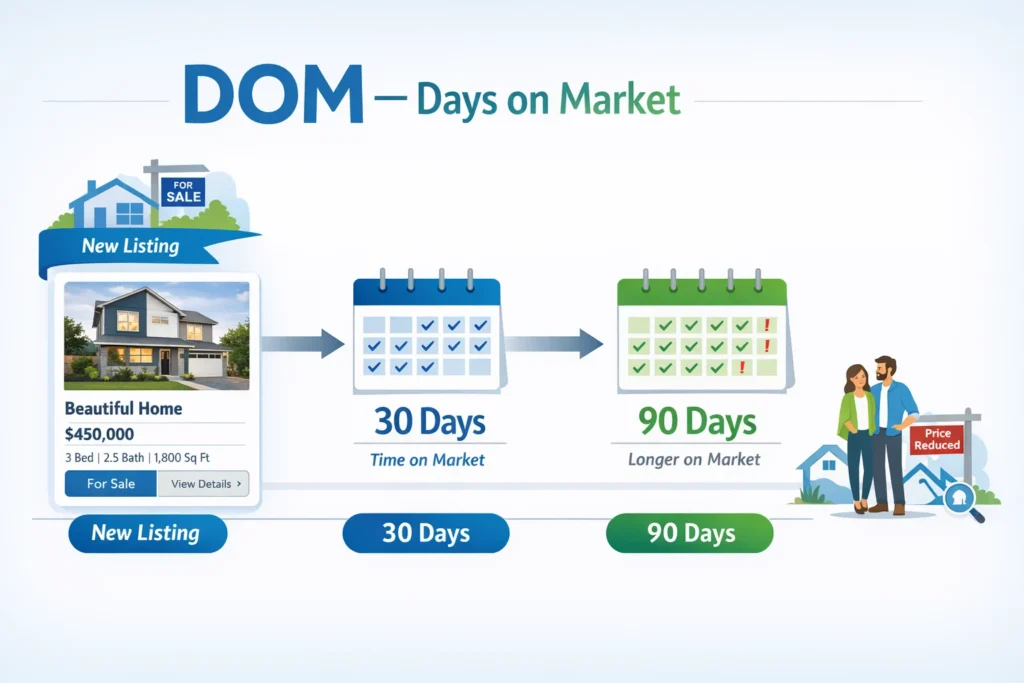
DOM in real estate stands for “Days on Market.” It refers to the total number of days a property has been listed for sale on the market before it receives an accepted offer or is removed from the listing.
In simple terms, DOM measures how long a home has been available for buyers.
Buying or selling a home often comes with a lot of unfamiliar real estate terms. When browsing property listings, you might notice abbreviations like DOM next to a home’s details. At first glance, it may seem confusing, but it actually provides valuable insight into how a property is performing in the housing market.
Understanding what DOM means in real estate can help buyers evaluate listings more effectively and help sellers understand whether their property is attracting interest. In many cases, the number of days a property stays on the market can influence buyer perception, pricing decisions, and negotiation opportunities.
In this complete guide, you’ll learn what DOM (Days on Market) means, why it matters in real estate transactions, how it’s calculated, and how buyers and sellers use it to make smarter decisions.
For example:
| Property Price | DOM | Listing Status |
|---|---|---|
| $350,000 | 8 | Active |
| $420,000 | 55 | Active |
| $290,000 | 12 | Pending |
Generally speaking:
- Low DOM often indicates high demand or competitive pricing
- High DOM may suggest pricing issues or lower buyer interest
However, DOM should always be considered alongside other factors like location, condition, and market trends.
Why DOM Matters in Real Estate
DOM plays a major role in both buyer decision-making and seller strategy.
For Home Buyers
Buyers often use DOM to evaluate whether a property might be negotiable.
If a listing shows:
- 1–15 days on market → strong demand, limited negotiation
- 30–60 days on market → typical market activity
- 90+ days on market → possible opportunity to negotiate price
A high DOM may encourage buyers to make lower offers, assuming the seller is eager to close the deal.
For Home Sellers
For sellers, DOM reflects how well a listing is performing.
If a property stays on the market too long, it may indicate:
- Overpricing
- Poor listing presentation
- Limited marketing exposure
- Local market slowdown
Real estate agents often monitor DOM to determine when to adjust pricing or marketing strategies.
Origin and Background of DOM in Real Estate
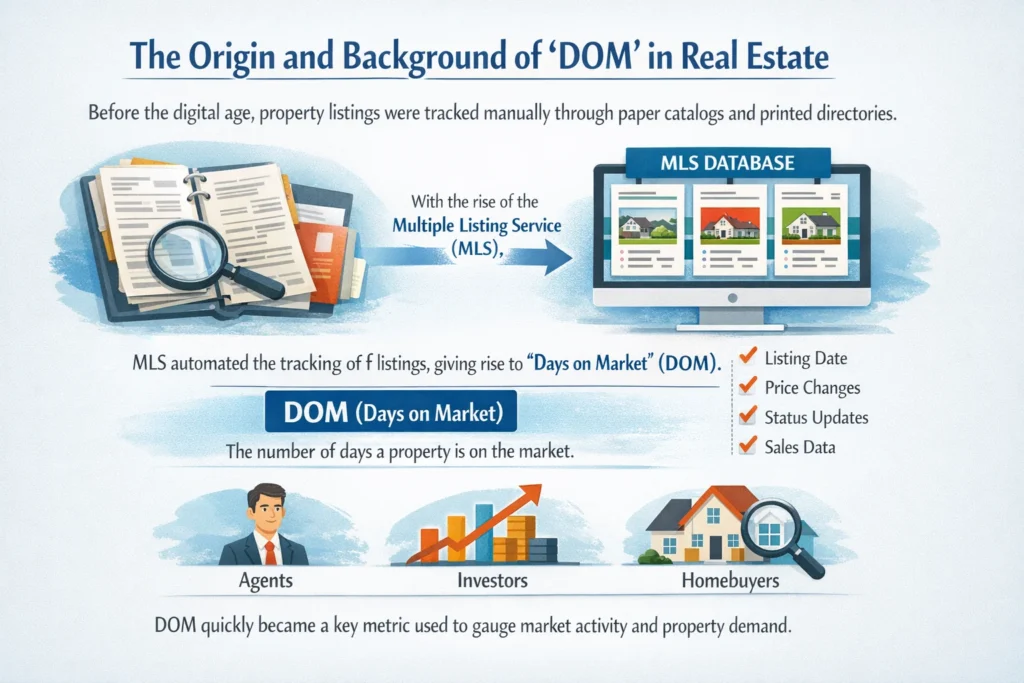
The concept of Days on Market became widely used with the rise of digital real estate listing systems.
Before the internet, property listings were managed manually through paper catalogs and printed directories. Tracking how long a property had been listed was difficult and inconsistent.
Everything changed when the Multiple Listing Service (MLS) became widely adopted.
MLS platforms automatically track listing data, including:
- Listing date
- Price changes
- Status updates
- Sale dates
Because of this automation, DOM quickly became a standard real estate metric used by agents, investors, analysts, and homebuyers.
Today, almost every property listing website displays DOM as a key indicator of market activity.
How DOM Is Calculated
Calculating DOM is straightforward.
It simply counts the number of days between the listing date and the date when the seller accepts an offer.
Basic Formula
DOM = Listing Date → Offer Acceptance Date
Example
| Event | Date |
|---|---|
| Home Listed | March 1 |
| Offer Accepted | March 18 |
DOM = 17 days
In many systems, DOM stops counting when the property status changes to Pending.
Examples of DOM in Real Estate Listings
To better understand how DOM appears in listings, here are some real-world scenarios.
| Scenario | DOM | What It Suggests |
|---|---|---|
| Brand new listing | 3 days | High buyer interest |
| Average sale time | 45 days | Normal market activity |
| Long listing | 120 days | Potential pricing issue |
| Hot property | 1 day | Multiple offers likely |
Example 1: Hot Market
A home in a desirable neighborhood receives multiple offers within the first week.
DOM: 5
Buyers may rush to submit offers before the property sells.
Example 2: Balanced Market
A property sells after about six weeks.
DOM: 42
This is typical for many balanced housing markets.
Example 3: Slow Market
A house stays listed for four months.
DOM: 120
Buyers may suspect pricing or property condition issues.
What Is Considered a Good DOM?
There is no universal “perfect” DOM because it depends on the local housing market conditions.
However, typical benchmarks look like this:
| Market Type | Average DOM |
|---|---|
| Seller’s Market | 5–20 days |
| Balanced Market | 30–60 days |
| Buyer’s Market | 60–120 days |
Seller’s Market
When demand is high and inventory is low:
- Homes sell quickly
- DOM stays very low
Buyer’s Market
When there are many homes available:
- Homes take longer to sell
- DOM increases significantly
DOM vs CDOM: Understanding the Difference
Another related term you may encounter is CDOM (Cumulative Days on Market).
| Term | Meaning |
|---|---|
| DOM | Days listed during the current listing period |
| CDOM | Total days listed across multiple listings |
Example
| Listing Period | DOM |
|---|---|
| First listing | 60 days |
| Relisted later | 30 days |
- DOM = 30 days
- CDOM = 90 days
CDOM helps prevent sellers from resetting the clock by relisting properties.
How DOM Affects Buyer Psychology
Buyers often use DOM as a quick signal of property desirability.
Low DOM Signals
- High demand area
- Competitive pricing
- Attractive property condition
High DOM Signals
- Possible overpricing
- Repairs needed
- Weak marketing strategy
However, a high DOM does not always mean something is wrong. Sometimes listings stay active longer due to:
- seasonal market trends
- financing delays
- buyer contract cancellations
Strategies to Reduce DOM (For Sellers)
If a home remains on the market too long, sellers can take several steps to improve interest.
Adjust the Price
Pricing a home correctly from the start is one of the most important factors in reducing DOM.
Improve Listing Photos
Professional photography dramatically improves online engagement.
Stage the Property
Home staging helps buyers visualize living in the space.
Increase Marketing Exposure
Agents may promote listings through:
- social media ads
- email campaigns
- virtual tours
- real estate websites
Real Estate Listing Example with DOM
Below is a simple example of how DOM appears in property listings.
| Property Detail | Example |
|---|---|
| Address | 123 Maple Street |
| Price | $410,000 |
| Bedrooms | 3 |
| Bathrooms | 2 |
| DOM | 21 days |
| Status | Active |
A buyer seeing 21 DOM may assume the property is still relatively fresh on the market.
Related Real Estate Terms Similar to DOM
Several real estate terms are commonly associated with DOM.
| Term | Meaning |
|---|---|
| MLS | Database of property listings used by agents |
| Active Listing | Property currently available |
| Pending | Offer accepted but not closed |
| Price Reduction | Seller lowered the listing price |
| Days to Close | Time between accepted offer and final sale |
These metrics help professionals evaluate market performance and property demand.
Alternate Meanings of DOM
Although DOM usually means Days on Market in real estate, the abbreviation can have other meanings depending on the context.
| Field | Meaning |
|---|---|
| Web development | Document Object Model |
| Internet slang | Dominant personality |
| Gaming | Dominant player |
In property listings, however, DOM almost always refers to Days on Market.
Professional Alternatives to the Term DOM
In some real estate reports or marketing materials, agents may use more descriptive phrases instead of the abbreviation DOM.
Common alternatives include:
- Time on market
- Listing duration
- Market exposure time
- Days listed
These alternatives make the concept easier for new buyers to understand.
FAQs
1. What does DOM mean in real estate listings?
DOM stands for Days on Market, which measures how long a property has been listed for sale before receiving an offer.
2. Is a low DOM good in real estate?
Yes. A low DOM typically indicates high buyer demand and competitive pricing.
3. What is considered a high DOM?
In many markets, a DOM of 90 days or more is considered relatively high.
4. Can sellers reset DOM?
Sometimes sellers relist a property to reset the DOM, but many listing systems track CDOM, which shows the full listing history.
5. Why do buyers pay attention to DOM?
Buyers use DOM to identify negotiation opportunities and market demand.
6. Does DOM include pending time?
Usually DOM stops counting when the listing status becomes pending, though this varies by listing platform.
7. What is the average DOM for homes?
In balanced markets, homes typically sell within 30 to 60 days.
8. Does a high DOM mean something is wrong with the property?
Not necessarily. High DOM can occur due to pricing strategy, seasonal demand changes, or previous buyers backing out.
Conclusion
Understanding what DOM means in real estate helps buyers and sellers interpret property listings more effectively.
To summarize:
- DOM stands for Days on Market
- It measures how long a property has been listed for sale
- Low DOM often indicates strong demand
- High DOM may suggest pricing or marketing issues
However, DOM should always be considered alongside other factors like location, price trends, property condition, and overall market conditions.
By paying attention to DOM, buyers can spot potential deals while sellers can improve their listing strategy and reduce the time it takes to sell a home.
Discover More Related Articles:

Ryan Thompson is an experienced content writer specializing in slang terms, texting abbreviations, and word meanings. He writes for meanvoro.com, where he creates accurate and easy-to-understand language content for readers.