
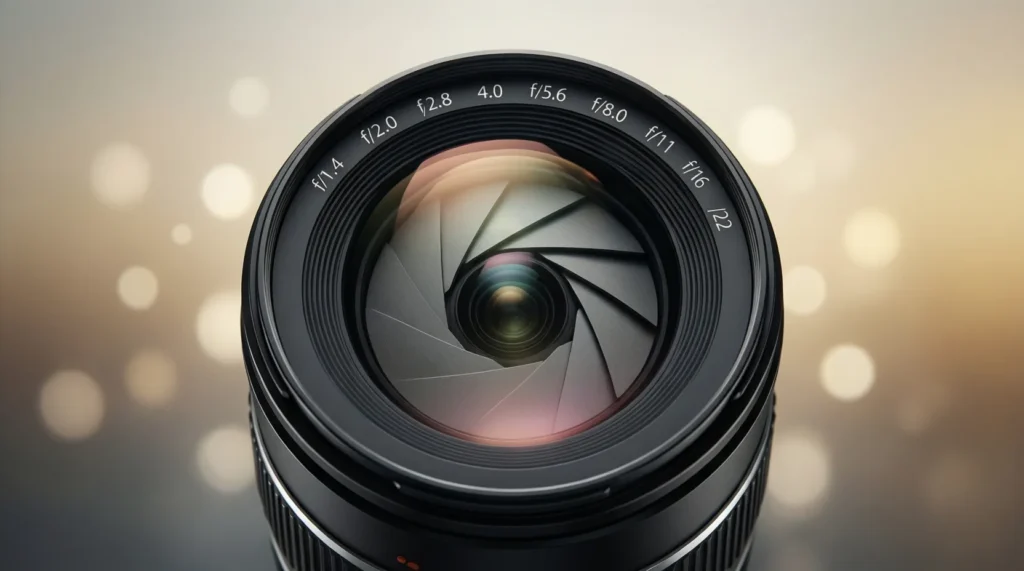
In photography, aperture refers to the adjustable opening inside a camera lens that controls how much light enters the camera.
It affects image brightness (exposure) and depth of field, which determines how much of the photo appears in focus.Aperture Mean in Photography is measured in f-stops such as f/1.8, f/4, and f/16.
Aperture is one of the most essential concepts in photography, yet it often confuses beginners. If you have ever wondered why some photos have beautifully blurred backgrounds while others are sharp from front to back, aperture is the reason.
It plays a major role in controlling light, focus, and the overall mood of a photograph.
Understanding what aperture means in photography helps you move beyond automatic mode and start taking creative control of your camera.
What Is Aperture in Photography?
Aperture is the opening inside a camera lens that lets light reach the camera sensor. This opening can become wider or narrower depending on your camera settings.
A simple way to understand aperture is to compare it to the human eye. In low light, your pupils expand to let in more light. In bright conditions, they shrink. A camera lens behaves in the same way.
A wider aperture allows more light and creates a blurred background. A smaller aperture allows less light and keeps more of the scene in focus.
How Aperture Is Measured: Understanding F-Stops
Aperture is measured using f-numbers, commonly called f-stops. These values describe the size of the lens opening.
Examples of common f-stops include:
- f/1.8
- f/2.8
- f/4
- f/5.6
- f/8
- f/11
- f/16
A key rule to remember is that a smaller f-number means a larger aperture opening, while a larger f-number means a smaller opening.
Aperture, Exposure, and Light Control
Aperture directly affects how bright or dark your image appears.
A wide aperture lets in more light, making photos brighter. A narrow aperture restricts light, resulting in a darker image. This makes aperture especially important when shooting in low-light environments such as indoors or at night.
Aperture works alongside shutter speed and ISO to achieve proper exposure.
Aperture and Depth of Field Explained
Depth of field refers to how much of the image is in focus from foreground to background.
Wide apertures create a shallow depth of field, where the subject is sharp but the background is blurred. Narrow apertures create a deep depth of field, keeping more of the image in focus.
Wide Aperture (f/1.8 to f/2.8)
- Strong background blur
- Subject stands out clearly
- Ideal for portraits and low-light photography
Narrow Aperture (f/8 to f/16)
- More of the scene remains sharp
- Ideal for landscapes and group photos
Common Aperture Values and Their Effects
| Aperture (f-stop) | Lens Opening | Light Intake | Depth of Field | Best Used For |
| f/1.8 – f/2.8 | Very wide | Very high | Very shallow | Portraits, low light |
| f/4 – f/5.6 | Medium | Moderate | Balanced | Everyday photography |
| f/8 – f/11 | Narrow | Low | Deep | Landscapes |
| f/16 – f/22 | Very narrow | Very low | Very deep | Architecture |
Examples
Portrait Photography (Friendly Tone)
A photographer may use f/1.8 to blur the background and keep all attention on the subject’s face.
Landscape Photography (Neutral Tone)
Using f/11 ensures the foreground, middle ground, and background remain sharp.
Beginner Mistake (Dismissive Context)
Shooting a group photo at f/1.8 often results in some people being out of focus.
Aperture Compared With Shutter Speed and ISO
| Camera Setting | What It Controls | Main Effect |
| Aperture | Lens opening | Light and depth of field |
| Shutter Speed | Time | Motion blur |
| ISO | Sensor sensitivity | Image noise |
Aperture is unique because it affects both technical exposure and artistic style.
Origin of the Term “Aperture”
The word aperture comes from the Latin word apertura, meaning “an opening.” It was originally used in science and optics before becoming a standard photography term in the 19th century. Its meaning has remained consistent over time.
Why Aperture Is So Popular in Photography
Aperture is widely discussed because it has a visible impact on photos. Background blur, subject isolation, and cinematic depth are all closely linked to aperture settings. Many professional-looking images rely heavily on wide apertures.
Related Photography Terms
- Wide open: Using the largest aperture a lens allows
- Stopping down: Choosing a smaller aperture
- Bokeh: The quality of background blur created by aperture
Alternate Meanings of Aperture
Outside photography, aperture can refer to:
- An opening in optics or engineering
- A biological or anatomical opening
- A scientific measurement in physics
In everyday language, photography is the most common usage.
Professional Alternatives to the Word “Aperture”
In instructional or formal writing, aperture may be replaced with:
- Lens opening
- Low f-stop setting
- Shallow depth-of-field setting
These alternatives are often used in professional tutorials.
Best Aperture Settings for Common Photography Types
- Portraits: f/1.8 to f/2.8
- Landscapes: f/8 to f/11
- Street photography: f/4 to f/8
- Group photos: f/5.6 to f/8
- Low light: f/1.8 to f/2.8
Beginner Tips for Using Aperture
- Use Aperture Priority mode to practice
- Test different f-stops on the same subject
- Avoid using extremely wide apertures for groups
- Always double-check focus
FAQs
What does aperture mean in photography?
Aperture is the adjustable opening in a camera lens that controls light and depth of field.
Is a lower f-stop always better?
No. Lower f-stops create blur but reduce focus depth.
Why are f-numbers written as fractions?
They represent a ratio based on focal length.
Does aperture affect image sharpness?
Yes. Extremely wide or narrow apertures can reduce sharpness.
What aperture should beginners use?
f/4 to f/5.6 is a good starting range.
Does aperture affect photo mood?
Yes. Wide apertures feel intimate, narrow apertures feel detailed.
What happens if aperture is too wide?
Parts of the image may fall out of focus.
Is aperture more important than ISO?
For creative control, yes.
Conclusion
Aperture is a foundational photography concept that controls light, focus, and creative style. By understanding how f-stops work and when to use wide or narrow apertures, photographers gain full control over the look and feel of their images.
Mastering aperture is a major step toward taking professional-quality photos.
Search More Related Articles :
- The Meaning of the Rainbow in the Bible : Explained for Christians (2026)
- VOC Paint Meaning: Low-VOC vs Traditional Paints Compared (2026)

Ryan Thompson is an experienced content writer specializing in slang terms, texting abbreviations, and word meanings. He writes for meanvoro.com, where he creates accurate and easy-to-understand language content for readers.