
Definition:
In Spanish, “no” means “no” in English and is used to express refusal, denial, disagreement, or negation. It is one of the most common and essential words in Spanish and is typically placed before a verb to make a sentence negative.
If you’re learning Spanish or simply curious about common Spanish words, you’ve probably come across the word “no.” It may look simple, but this tiny word plays a powerful role in everyday conversations. From refusing an offer to disagreeing with someone or making a sentence negative, “no” is one of the most frequently used words in the Spanish language.
Examples:
- “No quiero ir.” → “I do not want to go.”
- “No entiendo.” → “I don’t understand.”
Because it is simple and versatile, “no” appears frequently in everyday Spanish conversations, writing, and expressions.
Understanding the Meaning of “No” in Spanish
The basic meaning
The Spanish word “no” works almost exactly like the English word “no.”
It is commonly used to:
- Refuse something
- Disagree with someone
- Negate a statement
- Answer a question negatively
Examples:
- “¿Quieres café?” – “No.”
(Do you want coffee? – No.) - “No me gusta eso.”
(I don’t like that.)
Because it is a negation word, it changes the meaning of a sentence from positive to negative.
Why “no” is important in Spanish
“No” is one of the first words language learners encounter when studying Spanish.
Reasons it is important include:
- It forms negative sentences
- It helps express opinions and preferences
- It appears in daily conversations
- It is essential for basic communication
Without this simple word, expressing disagreement or refusal in Spanish would be difficult.
Origin of the Word “No”
Historical roots
The Spanish word “no” originates from the Latin word “non.”
Latin was the language spoken in the Roman Empire, and many modern languages evolved from it.
Over time:
- Latin “non” evolved into Spanish “no”
- Similar forms appeared in other languages
Examples:
| Language | Word for “No” |
|---|---|
| Spanish | no |
| Italian | no |
| French | non |
| Portuguese | não |
This shared origin explains why the word for “no” looks similar across several European languages.
How the word became common
As Spanish developed, “no” became the standard negation word used in speech and writing.
Today it appears in:
- Conversations
- Books
- Films and TV
- Social media
- Text messages
Because it is so simple and versatile, it remains one of the most frequently used Spanish words.
How “No” Is Used in Spanish Sentences
Placing “no” before a verb
The most common rule is placing “no” before a verb to make a sentence negative.
Examples:
- “No quiero salir.”
(I don’t want to go out.) - “No tengo dinero.”
(I don’t have money.) - “No sabemos la respuesta.”
(We don’t know the answer.)
This structure is essential for forming negative statements in Spanish.
Using “no” as a direct answer
Like English, Spanish allows “no” to stand alone as a response.
Example:
“¿Vienes conmigo?”
(Are you coming with me?)
Response:
“No.”
This means you are declining or refusing.
Using double negatives
Spanish grammar allows double negatives, which are completely normal.
Example:
“No quiero nada.”
Translation:
“I don’t want anything.”
Unlike English, double negatives in Spanish strengthen the negative meaning rather than making the sentence incorrect.
Examples of “No” in Everyday Spanish
Example conversation situations
| SituationSpanish SentenceEnglish Meaning | ||
|---|---|---|
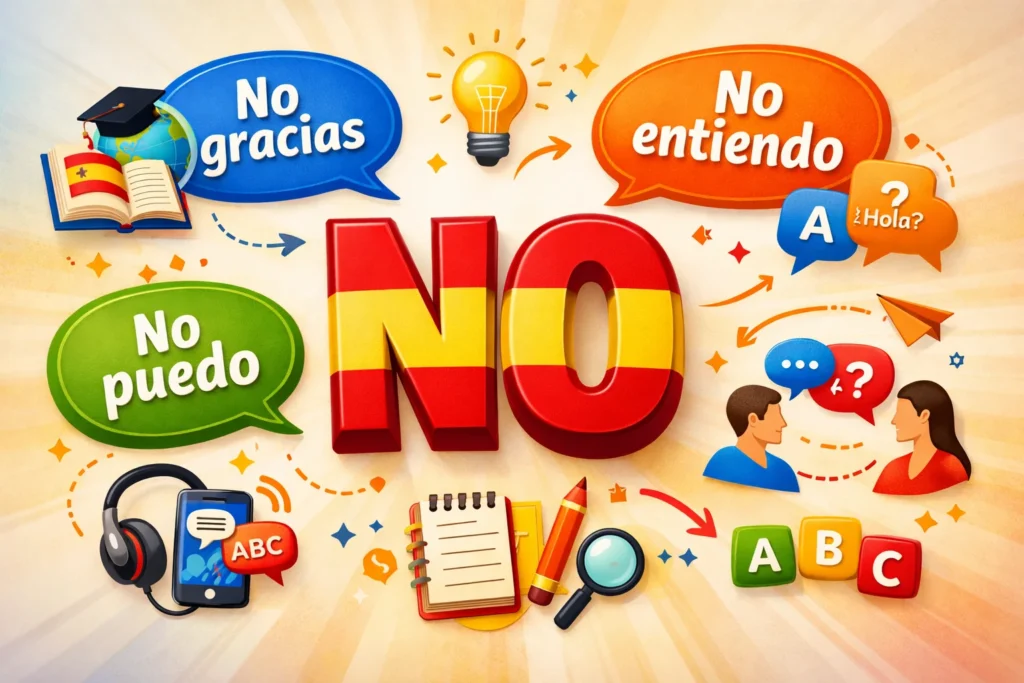
| Refusing food | “No, gracias.” | No, thank you |
| Disagreement | “No estoy de acuerdo.” | I don’t agree |
| Lack of understanding | “No entiendo.” | I don’t understand |
| Declining invitation | “No puedo ir.” | I can’t go |
| Denying something | “No es verdad.” | That is not true |
These examples show how the word “no” helps express clear communication in daily interactions.
Common Spanish Expressions Using “No”
Popular phrases with “no”
Spanish uses “no” in many everyday expressions.
Examples include:
- No hay problema → No problem
- No te preocupes → Don’t worry
- No tengo idea → I have no idea
- Para nada → Not at all
- De ninguna manera → No way
These phrases appear frequently in casual conversations and informal speech.
Tone and Context When Saying “No”
Direct vs polite responses
Although “no” simply means “no,” tone can change depending on how it is used.
Direct refusal:
“No.”
Polite refusal:
“No, gracias.”
Very polite response:
“Lo siento, pero no puedo.”
Meaning:
“I’m sorry, but I can’t.”
Tone plays an important role because a direct “no” can sometimes sound too abrupt.
How to soften a “no”
Spanish speakers often add extra words to make their refusal more polite.
Examples:
- “No, gracias.”
- “No puedo ahora.”
- “Lo siento, no es posible.”
These phrases help keep conversations respectful and friendly.
Comparison With Other Spanish Negative Words
Words related to “no”
Spanish also uses other negative words together with “no.”
| Word | Meaning | Example |
|---|---|---|
| nada | nothing | No quiero nada |
| nunca | never | Nunca voy allí |
| nadie | nobody | No veo a nadie |
| tampoco | neither | Yo tampoco |
Example sentence:
“No veo a nadie.”
Translation:
“I don’t see anybody.”
These words are commonly used alongside “no” to strengthen negation.
Alternate Meanings of “No”
Different contexts for “no”
Although “no” usually means “no,” context may slightly change its purpose.
Possible uses include:
- Refusal
- Denial
- Disagreement
- Correction
Example:
“Eso no es correcto.”
Meaning:
“That is not correct.”
Even in these situations, the core meaning still relates to negation or rejection.
Polite Alternatives to Saying “No”
Softer responses in Spanish
Sometimes people prefer alternatives that sound less direct.
Examples:
- “Tal vez después.” → Maybe later
- “No puedo ahora.” → I can’t right now
- “Quizás en otro momento.” → Maybe another time
- “Lo siento.” → I’m sorry
These responses allow speakers to decline something politely.
Practical Tips for Using “No” in Spanish
Remember the sentence structure
Always place “no” before the verb.
Correct example:
“No quiero eso.”
Incorrect example:
“Quiero no eso.”
Combine with polite expressions
Adding polite words makes communication smoother.
Example:
“No, gracias.”
Pay attention to context
Tone and body language can change how “no” is interpreted.
Understand double negatives
Spanish commonly uses double negatives.
Example:
“No quiero nada.”
This is grammatically correct in Spanish.
FAQs
What does “no” mean in Spanish?
“No” means “no” or “not” in English and is used to express negation, refusal, or disagreement.
Is “no” the same in English and Spanish?
Yes. The word “no” has the same spelling and similar meaning in both languages.
How is “no” used in Spanish sentences?
It is usually placed before a verb to make a sentence negative.
Example: “No entiendo.”
What does “no gracias” mean in Spanish?
“No gracias” means “No, thank you.”
Can Spanish sentences have double negatives?
Yes. Spanish grammar commonly allows double negatives, such as “No quiero nada.”
Does “no” always mean refusal?
Not always. It can also express disagreement, denial, or correction.
How do you say “not” in Spanish?
The word “no” is used to express “not” in most Spanish sentences.
Is saying “no” rude in Spanish?
It can sound direct, so people often soften it with polite phrases like “gracias” or “lo siento.”
Conclusion
The Spanish word “no” is one of the most essential words in the language. It plays a key role in expressing negation, refusal, disagreement, and correction.
Whether used alone or in a sentence, “no” allows speakers to communicate clearly and effectively.
Understanding how to use “no” correctly is a simple but important step toward speaking Spanish confidently.
Discover More Related Articles:
- Hallelujah Mean in the Bible: A Guide for Christians in 2026
- “Maron” Mean in Italian: How Italians Use This Word in 2026

Ryan Thompson is an experienced content writer specializing in slang terms, texting abbreviations, and word meanings. He writes for meanvoro.com, where he creates accurate and easy-to-understand language content for readers.