Definition:
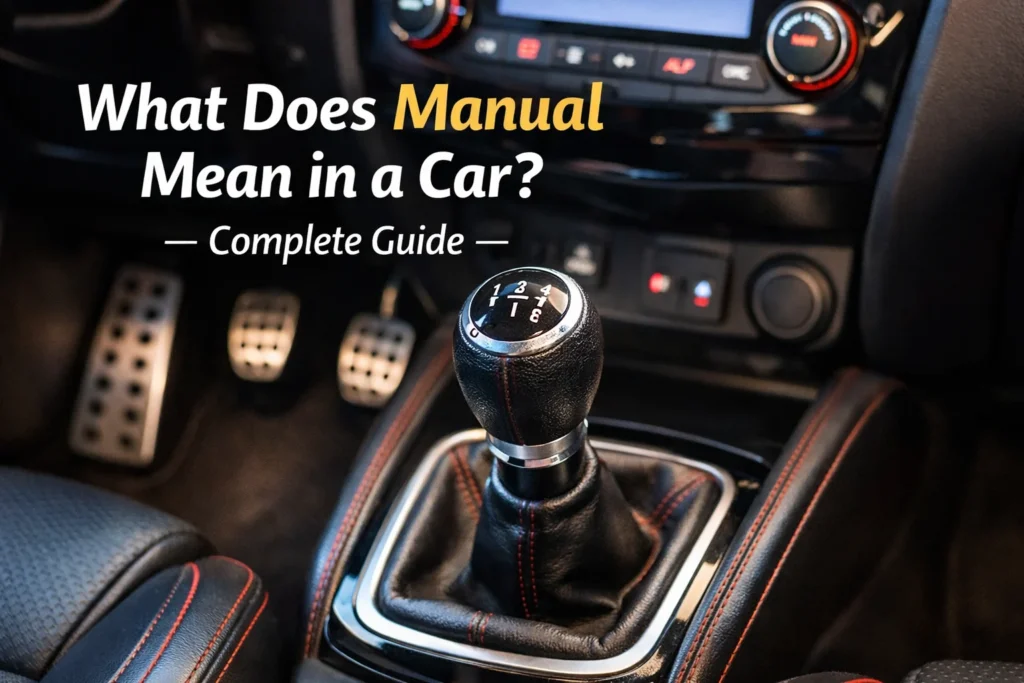
In a car, manual refers to a vehicle that requires the driver to manually operate the clutch and gear stick to change gears, unlike automatic cars where the transmission shifts gears on its own.
Manual cars are often called stick-shift cars, emphasizing the driver’s control over the vehicle’s speed and power.
Origin of Manual Cars
The concept of a manual transmission dates back to the early 20th century. The first widely recognized cars, like the Ford Model T (1908), relied on manual gear shifting because automatic transmissions were not yet invented.
Manual transmissions became popular because they were:
- Simpler in design – fewer parts meant lower maintenance.
- More affordable – cheaper to manufacture than automatic cars.
- Fuel-efficient – especially before the advent of modern automatic gearboxes.
Even today, manual cars are still widely used around the world, particularly in Europe, Asia, and developing countries, where cost and fuel efficiency are prioritized.
How Manual Cars Work
Driving a manual car involves coordinating three pedals and a gear stick:
| Component | Function |
|---|---|
| Clutch Pedal | Disconnects the engine from the wheels to change gears smoothly |
| Brake Pedal | Slows or stops the car |
| Accelerator Pedal | Controls speed |
| Gear Stick | Allows selection of different gears manually |
Basic Steps to Drive a Manual Car:
- Press the clutch pedal completely.
- Move the gear stick into first gear.
- Slowly release the clutch while pressing the accelerator.
- Shift up through gears as speed increases.
- Press clutch when stopping or changing gears.
Example: In a friendly context, you might hear: “I love my manual car—it feels more connected to the road! 🚗💨”
Popularity and Real-World Usage
Manual cars are most common in regions where:
- Fuel efficiency is crucial.
- Driving conditions require precise control, like mountainous areas.
- Car prices are lower and maintenance is manageable.
Current Trends:
- In Europe, about 60–70% of cars are manual.
- In the U.S., only about 2–3% of cars sold are manual.
The shift toward automatic and semi-automatic cars has grown due to:
- Convenience in city traffic.
- Easier learning curve for new drivers.
- Advanced automatic transmission technology.
Examples of “Manual” in Context
Friendly Tone:
- “Learning to drive a manual car gave me so much confidence on the road. 😎”
Neutral Tone:
- “Manual cars are standard in many European countries and are valued for their fuel efficiency.”
Dismissive Tone:
- “I don’t see the point of driving a manual—automatic cars are much easier in traffic!”
These examples show how context changes the perception of manual cars.
Comparison with Related Terms
| Term | Meaning | Key Difference |
|---|---|---|
| Manual Transmission | Driver shifts gears manually | Requires clutch pedal and gear stick |
| Automatic Transmission (Auto) | Car shifts gears automatically | No clutch pedal; easier for beginners |
| Semi-Automatic / Tiptronic | Hybrid system | Offers manual gear control without a clutch |
| CVT (Continuously Variable Transmission) | Smooth, stepless gear changes | No distinct gears; focuses on fuel efficiency |
Note: “Stick-shift” is another common term for manual cars, referencing the gear stick.
Alternate Meanings of “Manual” in Cars
While “manual” usually refers to the gearbox type, it can also mean:
- Manual operation of features – like windows, mirrors, or locks.
- Owner’s manual – the booklet that explains car functions.
These alternate meanings are less common in everyday driving conversations but worth noting.
Polite or Professional Alternatives
Instead of saying “I drive a manual,” you could use:
- “I drive a stick-shift car.”
- “My car has a manual transmission.”
- “I prefer vehicles with manual gear control.”
These phrases sound professional in work or formal conversations.
Example Table: Manual vs Automatic Driving Experience
| Feature | Manual Car | Automatic Car |
|---|---|---|
| Gear Control | Full control over shifts | Automatic shifting |
| Learning Curve | Steep for beginners | Easier for beginners |
| Fuel Efficiency | Potentially higher on highways | Better in city driving |
| Cost | Usually cheaper upfront | Slightly more expensive upfront |
| Maintenance | Fewer mechanical issues | More complex; higher repair cost |
| Driving Fun | More engaging, “sporty” feel | Less engaging, convenient |
Tips for Driving a Manual Car
- Practice on empty roads first – get comfortable with clutch and gear coordination.
- Listen to the engine sound – it signals when to shift gears.
- Don’t ride the clutch – resting your foot on the clutch while driving wears it out.
- Use neutral at stops – reduces fatigue and saves wear.
- Hill starts – use handbrake technique to prevent rollback.
With time, driving a manual car can become second nature, and many drivers prefer it for the connection it gives with the road.
FAQs
1. What is a manual car?
A car where the driver manually changes gears using a clutch and gear stick.
2. Why do people choose manual over automatic?
Manual cars offer better control, are often cheaper, and can be more fuel-efficient in certain situations.
3. Are manual cars harder to drive?
Yes, beginners usually find manual cars challenging until they master clutch and gear coordination.
4. What is the difference between manual and automatic cars?
Manual requires the driver to shift gears; automatic shifts gears on its own.
5. Can you learn manual driving quickly?
Yes, most people can learn the basics in 1–2 weeks of practice, depending on traffic conditions.
6. Do manual cars save fuel?
They can, especially on highways, but modern automatics are often more fuel-efficient in city traffic.
7. Is it expensive to maintain a manual car?
Generally, no. Manual transmissions have fewer parts, making them cheaper to repair than automatic transmissions.
8. Can manual cars be more fun to drive?
Many driving enthusiasts say yes manual cars offer more engagement and control on the road. 🚗🎯
Conclusion
Understanding what manual means in a car is key for anyone learning to drive or choosing a vehicle. Manual cars offer:
- Full control over gear changes
- Potential fuel efficiency
- Lower maintenance costs
- A more engaging driving experience
While automatic cars dominate in convenience, manual cars remain popular in regions where cost, fuel economy, and driving enjoyment matter. 🚗✨
Pro Tip: If you want full control and fun driving, learning a manual car is a skill worth investing in. For city commuting or ease of use, automatic might be the better choice.
Discover More Related Articles:

Ryan Thompson is an experienced content writer specializing in slang terms, texting abbreviations, and word meanings. He writes for meanvoro.com, where he creates accurate and easy-to-understand language content for readers.