
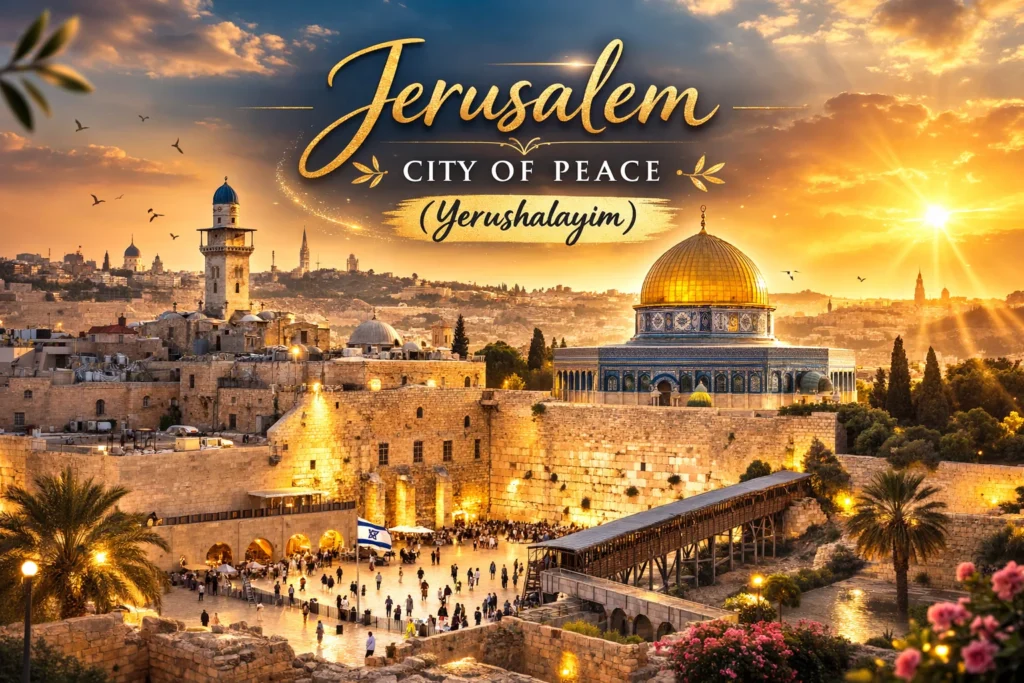
Definition:
Jerusalem (Hebrew: יְרוּשָׁלַיִם, Yerushalayim) is traditionally interpreted as “City of Peace” or “Foundation of Peace” in Hebrew, symbolizing spiritual unity, holiness, and historical importance in Jewish, Christian, and Islamic traditions.
Jerusalem is more than just a city it is a name steeped in history, faith, and culture. But what does Jerusalem truly mean in Hebrew, and why has this name captivated hearts and minds for thousands of years? In this article, we’ll explore its origins, usage, examples, comparisons, and even answer the most common questions about this ancient and revered term.
The Origin of the Name “Jerusalem”
Understanding the meaning of Jerusalem requires a look at its Hebrew roots and historical context.
Hebrew Roots
- יְרוּשָׁלַיִם (Yerushalayim)
The Hebrew name “Yerushalayim” combines two elements:- Yeru – possibly related to the verb “yarah” (to found, lay a foundation, or teach).
- Shalayim / Shalem – associated with “shalom,” meaning peace, completeness, or wholeness.
💡 Interpretation: Put together, Jerusalem can be understood as the “Foundation of Peace” or the “City of Peace.”
Historical Context
- Ancient References: Jerusalem appears in Egyptian texts dating back to the 19th century BCE, and in the Hebrew Bible as Urushalim or Yerushalayim.
- Religious Significance: It is considered the spiritual center in Judaism, revered in Christianity, and respected in Islam.
Popularity
Jerusalem is one of the most recognized city names in the world due to its religious, historical, and political significance. Its name is widely used in literature, songs, prayers, and cultural references.
Real-World Usage of “Jerusalem”
Everyday Contexts
- Religious: Referring to holy sites like the Temple Mount or the Western Wall.
- Cultural: Used in literature, poetry, and music to symbolize peace, faith, or spiritual aspiration.
- Political: Appears in news media and diplomatic discussions due to its geopolitical importance.
Example Sentences
| Tone | Example |
|---|---|
| Friendly | “Visiting Jerusalem was a dream come true—it truly feels like the heart of history!” 🕊️ |
| Neutral | “Jerusalem is the capital city of Israel and holds religious significance for multiple faiths.” |
| Formal | “The municipal planning of Jerusalem reflects a blend of modern infrastructure and historical preservation.” |
| Dismissive | “I don’t see what all the fuss is about Jerusalem; it’s just another city.” |
Comparing Jerusalem with Related Terms
Related Terms in Hebrew
| Term | Meaning in Hebrew | Contextual Use |
|---|---|---|
| Shalem (שָׁלֵם) | Completeness or peace | Root of “Yerushalayim,” used in older texts |
| Zion (צִיּוֹן) | A hill in Jerusalem; symbol of the Jewish homeland | Often used poetically or in religious songs |
| Yerushalaim (variant) | Ancient spelling variant | Seen in historical documents or inscriptions |
Key Comparison
- Jerusalem vs. Zion:
Zion can refer to a specific area within Jerusalem or symbolically to the Jewish homeland, while Jerusalem refers to the city as a whole. - Jerusalem vs. Holy City:
“Holy City” is a title emphasizing spiritual significance, whereas Jerusalem is the proper noun.
Alternate Meanings of Jerusalem
While primarily meaning “City of Peace” in Hebrew, Jerusalem can also convey:
- Spiritual Wholeness: Reflecting religious harmony or unity.
- Cultural Identity: Representing Jewish heritage and history.
- Symbolic Peace: Often used metaphorically in literature and poetry.
Polite and Professional Alternatives
If you want to reference Jerusalem in a professional, academic, or sensitive context, consider using:
- The City of Peace – emphasizes the literal Hebrew meaning.
- Yerushalayim – the transliteration of the Hebrew name.
- The Holy City – neutral, interfaith-friendly term.
- Historical Jerusalem – when discussing archaeology, history, or research.
💡 Usage Tip: Use the original Hebrew name “Yerushalayim” when writing scholarly articles or religious texts to show respect for tradition.
Examples of Jerusalem in Context
Jerusalem appears in various contexts, each with a slightly different nuance:
Religious Texts
- Hebrew Bible: Jerusalem is the site of King Solomon’s Temple and the spiritual center of the Israelites.
- Christianity: Associated with Jesus’ crucifixion and resurrection.
- Islam: The Al-Aqsa Mosque and Dome of the Rock highlight its Islamic significance.
Literary and Cultural Usage
- Poetry often depicts Jerusalem as a symbol of peace or longing.
- Songs use Jerusalem metaphorically, e.g., “Jerusalem of Gold” celebrates its beauty and spiritual weight.
Modern References
- Tourism: “Explore the ancient streets of Jerusalem.”
- Politics: “The status of Jerusalem remains a central issue in Middle Eastern diplomacy.”
- Pop Culture: Films, novels, and songs often invoke Jerusalem for its historic and symbolic weight.
FAQs
- What does the name Jerusalem literally mean?
Jerusalem in Hebrew (Yerushalayim) literally means “City of Peace” or “Foundation of Peace.” - Why is Jerusalem important in Judaism?
It is the spiritual center, home to the ancient Temple, and the direction of prayer. - Is Jerusalem the capital of Israel?
Yes, Israel designates Jerusalem as its capital, though international recognition varies. - What are some alternate spellings of Jerusalem?
Yerushalayim, Urushalim, and Yerushalaim are common historical and transliterated variants. - Does the name Jerusalem appear in the Bible?
Yes, it is mentioned hundreds of times in the Hebrew Bible and Old Testament. - How is Jerusalem used metaphorically?
It symbolizes peace, holiness, spiritual aspiration, or cultural identity. - Are there other meanings for Jerusalem in different languages?
While “City of Peace” is standard in Hebrew, Arabic (Al-Quds) emphasizes sanctity, meaning “The Holy.” - What is the difference between Zion and Jerusalem?
Zion can be a specific hill or metaphor for the Jewish homeland, whereas Jerusalem refers to the city itself.
Conclusion
Jerusalem is far more than just a city it is a name rich with history, spirituality, and cultural significance. In Hebrew, Yerushalayim is traditionally understood as the “City of Peace” or “Foundation of Peace,” reflecting both its sacred heritage and its enduring symbolism.
Whether you encounter Jerusalem in religious texts, literature, songs, or everyday conversation, it carries a sense of unity, wholeness, and reverence that transcends time and borders. From the bustling streets and ancient walls to its role in global history, the city embodies layers of meaning that are both literal and metaphorical.
✅ Practical Tip: When writing or speaking about Jerusalem, choose your term based on context academic, religious, or cultural to convey respect and clarity.
Discover More Related Articles:
- Perseverance Mean in the Bible: Lessons from Paul, Job, and Jesus for 2026
- Subdue Meaning in the Bible: Lessons for 2026

Madison Taylor is an experienced content writer who focuses on researching and explaining word meanings, slang, and texting terms. She writes for meanvoro.com, creating clear and accurate to help readers understand language easily.