
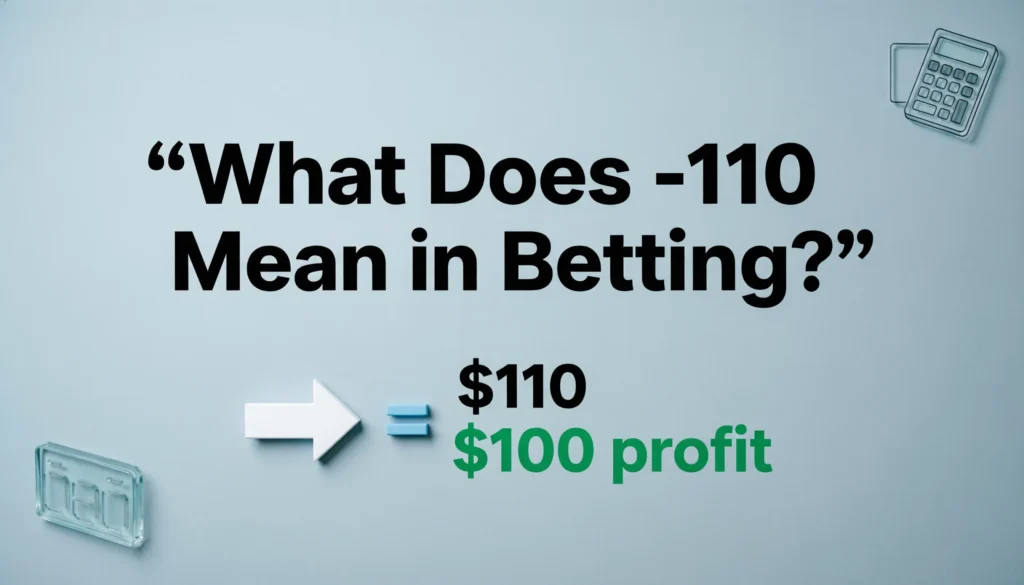
Definition:
In sports betting, -110 means you must risk $110 to win $100. The minus sign shows the bet is the favorite or evenly priced, and the extra $10 represents the bookmaker’s commission, often called the vig or juice.
If you’ve ever looked at betting odds and thought, “Why am I risking more than I win?” you’re not alone. The -110 betting line is one of the most common (and most confusing) odds formats, especially for beginners.
This guide breaks it down clearly, safely, and responsibly no hype, no pressure just understanding what the number actually means and why it’s everywhere in sports betting.
🔍 What Does -110 Mean in Betting?
-110 odds mean you need to wager $110 to profit $100 if your bet wins.
If your bet loses, you lose the full $110.
The minus (-) indicates:
- The bet is slightly favored or evenly balanced
- The sportsbook is charging a built-in fee (vig)
This format is most common in point spreads and totals (over/under bets).
📌 Why Is -110 So Common in Sports Betting?
If you’ve seen betting lines before, you’ve probably noticed -110 appears everywhere. That’s not random.
The short answer:
Sportsbooks use -110 because it helps them make money regardless of the outcome.
The longer answer:
- Most point spreads aim for 50/50 outcomes
- Both sides are usually priced at -110
- The extra $10 over $100 is the sportsbook’s commission
This system keeps betting markets balanced and predictable for bookmakers.
🧠 Understanding American Odds
-110 is written in American odds format, which uses plus (+) and minus (–) signs.
How American odds work:
| Odds Type | Meaning |
|---|---|
| Negative odds (-110) | How much you must risk to win $100 |
| Positive odds (+150) | How much you win on a $100 bet |
So:
- -110 → Risk $110 to win $100
- +150 → Risk $100 to win $150
🏈 Real-World Example of -110 Odds
Let’s say there’s a football game:
Team A -3.5 (-110)
Team B +3.5 (-110)
What this means:
- You’re betting against the point spread
- Both sides are evenly priced
- The sportsbook takes a small cut either way
If you bet $110:
- ✅ Win: You get $210 back ($110 stake + $100 profit)
- ❌ Lose: You lose $110
📊 Example Table: -110 Betting Outcomes
| Bet Amount | Profit If You Win | Total Payout | Loss If You Lose |
|---|---|---|---|
| $11 | $10 | $21 | $11 |
| $55 | $50 | $105 | $55 |
| $110 | $100 | $210 | $110 |
| $220 | $200 | $420 | $220 |
📌 The ratio always stays the same: risk slightly more than you win.
💰 What Is the Vig (Juice) in -110 Betting?
The vig (short for vigorish) is the sportsbook’s fee.
Why it matters:
- Even if bets are split evenly, sportsbooks profit
- That extra $10 per $100 adds up fast
Example:
If 100 people bet $110 on both sides:
- Total collected: $22,000
- Total paid out: $20,000
- Sportsbook keeps: $2,000
That’s why -110 is the industry standard.
⚖️ Is -110 Good or Bad Odds?
Neither it’s neutral.
- 👍 Good for beginners because it’s simple and consistent
- ⚠️ Not ideal for long-term profit without strong accuracy
The break-even point:
To profit at -110 odds, you must win 52.38% of your bets.
Anything less, and the vig eats into returns.
🔄 -110 vs Other Common Betting Odds
Comparison Table
| Odds | Risk | Profit | Implied Win Rate |
|---|---|---|---|
| -110 | $110 | $100 | 52.38% |
| -120 | $120 | $100 | 54.55% |
| -105 | $105 | $100 | 51.22% |
| +100 | $100 | $100 | 50% |
📌 Lower negative numbers = better value for the bettor.
🧾 Where You’ll Most Often See -110 Odds
- Point spreads (NFL, NBA, NCAA)
- Over/under totals
- Player prop bets
- Alternate lines
It’s rare for moneylines to sit at -110 unless teams are extremely evenly matched.
🧩 Are There Alternate Meanings of -110?
In betting, -110 has one primary meaning.
Outside betting, -110 can mean:
- A temperature reading (–110°)
- A numerical value in math or science
- A highway route number (context dependent)
📌 Always check context but in sports betting, it almost always refers to odds.
🧠 Responsible Understanding
This article explains what -110 means, not how or why to place bets.
If you’re under legal age or prefer not to gamble:
- Understanding odds is still useful for math literacy
- Many fans learn odds simply to follow sports discussions
No pressure. No promotion. Just clarity.
❓ FAQs:
1. What does -110 mean on a betting line?
It means you must wager $110 to win $100 in profit.
2. Why do sportsbooks use -110 odds?
To include a commission (vig) while keeping bets balanced.
3. Is -110 a favorite?
Yes, slightly or it may indicate evenly matched sides.
4. How much do you win on a $50 bet at -110?
You win about $45.45 in profit.
5. What sport uses -110 odds the most?
Football and basketball point spreads.
6. Is -110 better than -120?
Yes you risk less money for the same return.
7. Can you find bets better than -110?
Sometimes, especially with promotions or line shopping.
8. Do all sportsbooks use -110?
Most do, but some offer reduced-vig lines like -105.
🧾 Practical Tips for Understanding -110 Odds
- Always separate risk from profit
- Focus on percentages, not just payouts
- Remember the 52.38% break-even rule
- Never assume -110 means “easy” or “safe”
✅ Conclusion:
To sum it up, -110 in betting simply means you risk $110 to win $100 in profit. The minus sign shows the sportsbook is charging a small commission known as the vig or juice while keeping both sides of a bet evenly priced.
-110 doesn’t mean a sure thing.
It simply means:
- The odds are balanced
- The sportsbook takes a small cut
- You must win more than half the time to profit
Once you understand that, the mystery disappears and betting lines suddenly make a lot more sense.
Discover More Related Articles:
- Perseverance Mean in the Bible: Lessons from Paul, Job, and Jesus for 2026
- Subdue Meaning in the Bible: Lessons for 2026

Madison Taylor is an experienced content writer who focuses on researching and explaining word meanings, slang, and texting terms. She writes for meanvoro.com, creating clear and accurate to help readers understand language easily.