
Definition:
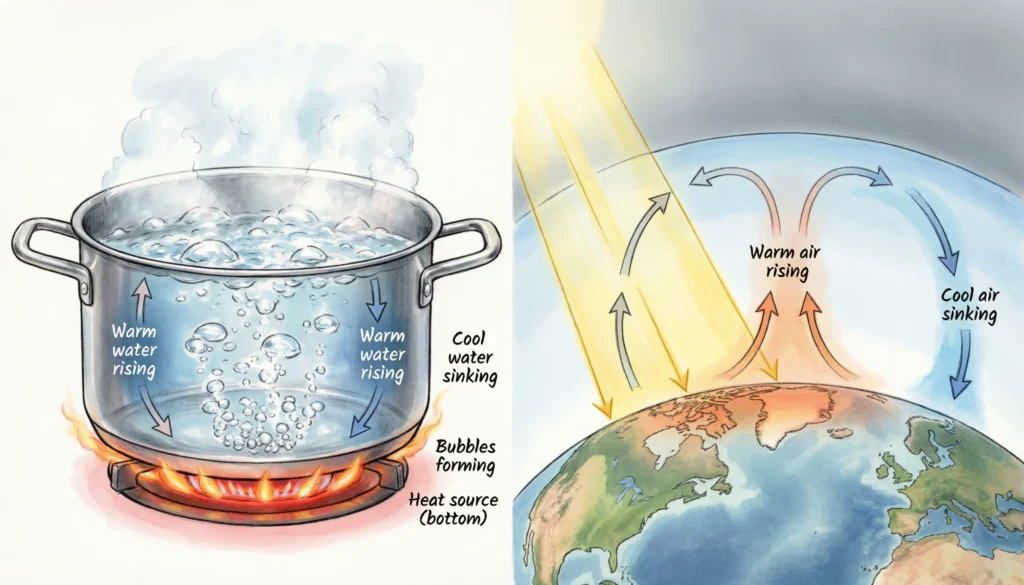
Convection in science is the process of heat transfer through the movement of fluids (liids or gases). It occurs when warmer, less dense fluid rises and cooler, denser fluid sinks, creating a continuous circulation pattern.
Convection is one of the three main ways heat moves in nature, and it plays a major role in everything from boiling water to ocean currents and even weather systems. If you’ve ever watched steam rise from a hot drink or felt warm air from a heater move upward, you’ve witnessed convection in action.
In this article, we’ll break down what convection means, how it works, its types, examples, comparisons with other heat transfer methods, and why it matters in everyday life.
Origin of the Word “Convection”
The term convection comes from the Latin word convectionem, meaning “a carrying together” or “bringing.” This makes sense because convection involves the movement or carrying of heat from one place to another.
Scientists began formally studying convection during early experiments in thermodynamics. Over time, it became recognized as one of the three fundamental heat transfer mechanisms alongside:
- Conduction
- Radiation
- Convection
Today, convection is a foundational concept in physics, chemistry, earth science, and engineering.
How Convection Works
Convection happens because of differences in temperature and density within a fluid.
Here’s the step-by-step process:
- A fluid (like air or water) is heated.
- The heated fluid becomes less dense.
- The less dense fluid rises.
- Cooler, denser fluid sinks to replace it.
- The cycle continues, forming a convection current.
This continuous movement is called a convection current.
Simple Example: Boiling Water
- Water at the bottom of the pot heats first.
- It rises as it becomes warmer.
- Cooler water sinks.
- The process repeats until the entire pot heats evenly.
That circulating motion is convection.
Types of Convection
There are two main types of convection in science:
1. Natural Convection
Natural convection happens without external force. It occurs due to natural temperature differences.
Examples:
- Warm air rising in a room
- Ocean currents
- Wind patterns
- Lava movement beneath Earth’s crust
2. Forced Convection
Forced convection occurs when an external device moves the fluid.
Examples:
- Fans blowing air
- Air conditioning systems
- Convection ovens
- Radiators with built-in fans
Examples of Convection in Everyday Life
Convection is everywhere around us.
| Situation | How Convection Happens | Result |
|---|---|---|
| Boiling water | Hot water rises, cool water sinks | Even heating |
| Room heating | Warm air rises from heater | Warmer upper air |
| Sea breeze | Warm land air rises, cool ocean air moves in | Wind forms |
| Weather systems | Warm air masses rise, cool air sinks | Storm formation |
| Convection oven | Fan circulates hot air | Faster cooking |
Once you understand convection, you start noticing it everywhere.
Convection in Earth Science
Convection plays a huge role inside Earth.
In the Atmosphere
Warm air rises, cool air sinks. This drives:
- Cloud formation
- Wind systems
- Storm development
In the Oceans
Temperature differences create ocean currents that:
- Regulate global climate
- Distribute heat around the planet
Inside Earth’s Mantle
Convection currents deep inside Earth move tectonic plates. This leads to:
- Earthquakes
- Volcanoes
- Continental drift
Convection literally shapes our planet.
Comparison: Convection vs Other Heat Transfer Methods
There are three primary heat transfer processes in science.
| Heat Transfer Type | How It Works | Requires Movement? | Example |
|---|---|---|---|
| Conduction | Heat transfers through direct contact | No | Touching a hot pan |
| Convection | Heat transfers through fluid movement | Yes | Boiling water |
| Radiation | Heat transfers through waves | No | Sun warming Earth |
Key Difference:
Convection requires fluid movement. Conduction and radiation do not.
Convection Currents Explained Simply
A convection current is the circular movement caused by heating and cooling.
Imagine a lava lamp:
- The wax heats up.
- It rises.
- It cools.
- It sinks.
- The cycle repeats.
That circular pattern is a convection current.
Why Convection Matters
Convection is important because it:
- Distributes heat evenly
- Controls weather systems
- Drives ocean circulation
- Influences climate
- Helps cook food efficiently
- Supports engineering systems
Without convection, Earth’s climate and atmosphere would function very differently.
Common Scientific Terms Related to Convection
| Term | Meaning |
|---|---|
| Fluid | A substance that flows (liquid or gas) |
| Density | How tightly packed particles are |
| Convection current | Circular movement caused by heat differences |
| Thermal energy | Energy from heat |
| Buoyancy | Upward force that allows warm fluid to rise |
Understanding these terms helps you fully grasp convection.
Alternate Meanings of Convection
In most contexts, convection refers to heat transfer in science. However, the word can sometimes appear in:
- Meteorology
- Engineering
- Cooking
- Climate science
Regardless of field, the core meaning remains: heat transfer through fluid movement.
Practical Tips for Students
If you’re studying convection:
- Remember: warm rises, cool sinks.
- Associate it with circular movement.
- Use real-life examples to understand it.
- Compare it to conduction and radiation.
- Practice drawing convection current diagrams.
A quick memory trick:
Convection = Circulation.
FAQs
- What does convection mean in simple terms?
It is the transfer of heat through the movement of liquids or gases. - What is a convection current?
A circular motion formed when warm fluid rises and cool fluid sinks. - Where does convection occur?
In the atmosphere, oceans, Earth’s mantle, and everyday situations like boiling water. - Is convection natural or man-made?
It can be both. Natural convection happens automatically, while forced convection uses machines like fans. - How is convection different from conduction?
Convection requires fluid movement. Conduction requires direct contact. - Why does warm air rise?
Because it becomes less dense than cooler air. - What is an example of forced convection?
A fan circulating warm air in a room. - Is convection important for weather?
Yes, it drives storms, wind patterns, and cloud formation.
Conclusion
Convection is a fundamental scientific process that moves heat through fluids using natural circulation. Whether it’s boiling water, warming a room, forming clouds, or shifting tectonic plates, convection is constantly shaping our world.
Once you understand convection, you’ll start noticing it in everyday life and major global systems alike.
Discover More Related Articles:

Ryan Thompson is an experienced content writer specializing in slang terms, texting abbreviations, and word meanings. He writes for meanvoro.com, where he creates accurate and easy-to-understand language content for readers.